How to Set a Morning Routine That Sticks
Build a morning routine that sticks: write a short sticky sequence, stage the night before, stand before you scroll, and keep a 2-step minimum for messy days. Read one step at a time. Start with the preflight. Hitting snooze? See Snooze trap. Phone eats the morning? See Phone hijack. One miss and you quit? See All-or-nothing.
Tips for reading this guide
- One step at a time. Read the green caption, the Why line, then the bullets.
- Move on when the green done line is true — then go to the next step.
- Short beats perfect. A 10–20 minute sticky sticks; a fantasy list does not.
- Snooze loop? See Snooze trap. Phone first? See Phone hijack.
- Need help? Ask a housemate to put your alarm across the room tonight.
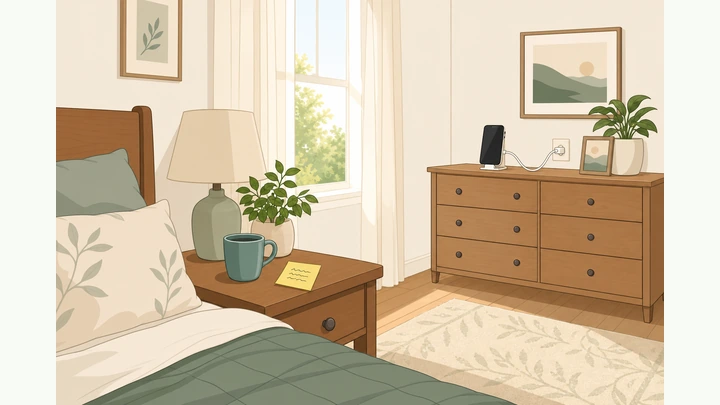
Things You'll Need
- Sticky notes or paper and pen for the sequence and minimum
- An alarm across the room (phone or a cheap clock)
- Night-before setup: clothes, water, journal, or coffee gear
- A park spot for the phone until the sequence is done
- Optional kitchen timer so you do not unlock just for timing
- A wall calendar or simple check marks for three proof mornings
Where are you stuck?
Follow Start here to build a sticky morning. Jump to a branch for snooze, phone-first mornings, or all-or-nothing collapse.
- I want a morning routine that sticks from scratch Sticky · night setup · stand before scroll · lock v1
- I keep hitting snooze / staying in bed Alarm across room · stand first · run minimum
- My phone eats the morning before I start Lock · park phone · timer · minimum · charge elsewhere
- One miss and I quit the whole routine Minimum · done enough · keep tomorrow unchanged
Start hereWrite sticky → night setup → alarm across room → stand before scroll → run list or minimum → lock v1
Preflight — real wake window, 3–5 actions max, written minimum, phone rule.
Wake window real · 3–5 actions max · bad-day minimum · phone rule written.
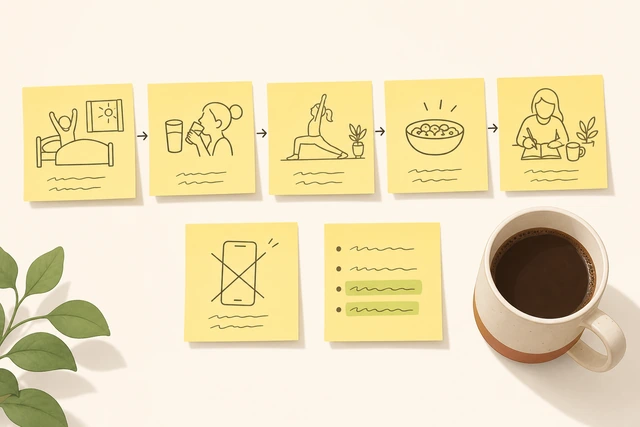
A fantasy list collapses on weekdays — a short written plan plus a minimum version makes the morning finishable.
- Window? Pick a wake time that matches real life (work, kids, commute) — not a vacation morning.
- List? Choose at most 3–5 morning actions and write a 2-step minimum for bad days.
- Phone? Decide: unlock only after the sequence, or charge outside the bedroom.
Wake window, short sequence, minimum line, and phone rule are written before the first attempt.
Worried you will hit snooze? → Snooze trap.
Pick one anchor cue you already do.
One cue named · already in your morning · short phrase on sticky.
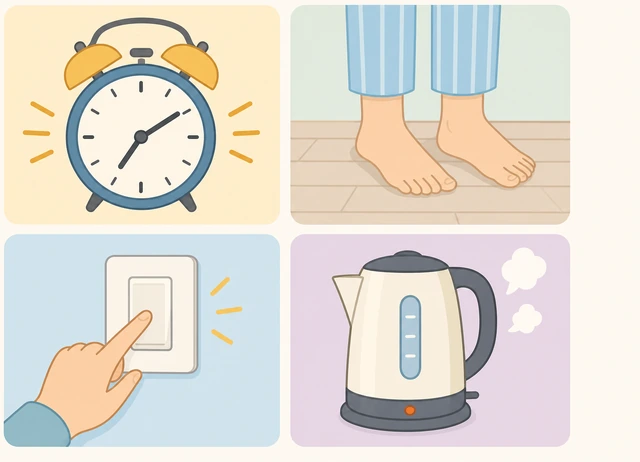
New habits stick to old cues — an anchor you already do starts the sequence without a willpower debate.
- Choose one cue you already do most mornings (alarm off, feet on floor, bathroom light, fill kettle).
- Write that cue as a short phrase on the sticky note.
- Do not invent a brand-new ritual as the start — attach to something real.
The anchor cue is named in one short phrase on the sticky.
Write the sequence in order: cue, then action 1, 2, 3.
Cue first · then 1–3 actions · max five total · glance-readable.
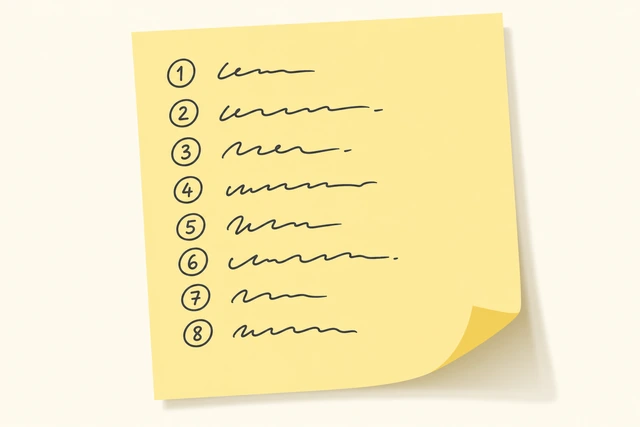
Order removes morning decision fatigue — you follow the sticky instead of inventing a plan while half awake.
- Write cue, then actions in the order you will do them.
- Keep the whole list to five items or fewer.
- Make each line short enough to read at a glance in dim light.
A sticky shows cue plus actions in order, five items or fewer.
Time-box the sequence (about 10–20 minutes).
Clock target written · 10–20 minutes · not a life makeover.
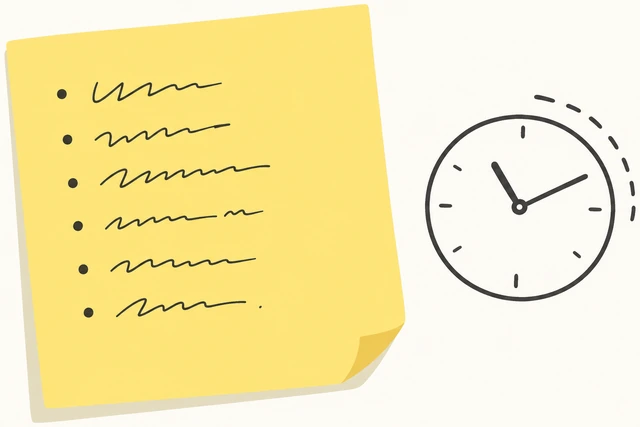
Without a time box the list expands until it feels impossible — a short window keeps it doable on weekdays.
- Pick a realistic window (often 10–20 minutes).
- Write the minutes next to the list.
- If the list needs more time, cut an action — do not stretch the fantasy.
A clock target is written next to the sequence.
Stage the night-before setup within arm's reach.
Clothes or kit · water · journal or coffee gear · laid out before sleep.

Searching for socks or coffee at 6 a.m. kills momentum — night-before staging removes friction.
- Lay out clothes, water, journal, or coffee gear where you will need them.
- Put at least one item within arm's reach of where you stand after waking.
- Do this before you go to sleep, not after the alarm.
At least one setup item is laid out before sleep.
Place the alarm across the room — no snooze-as-plan.
Alarm across room · not on pillow · snooze is not the plan.

An alarm on the nightstand makes snooze and scroll too easy — distance forces a physical start.
- Put the phone or alarm clock across the room on a dresser or shelf.
- Do not keep it on the pillow or nightstand as the default.
- If you use the phone as alarm, plan to stand before unlocking.
The alarm is across the room, not on the pillow.
Already stuck in a snooze loop? → Snooze trap.
Wake: stand within 60 seconds — feet down before any scroll.
Alarm rings · sit up · feet on floor · stand · phone still locked.
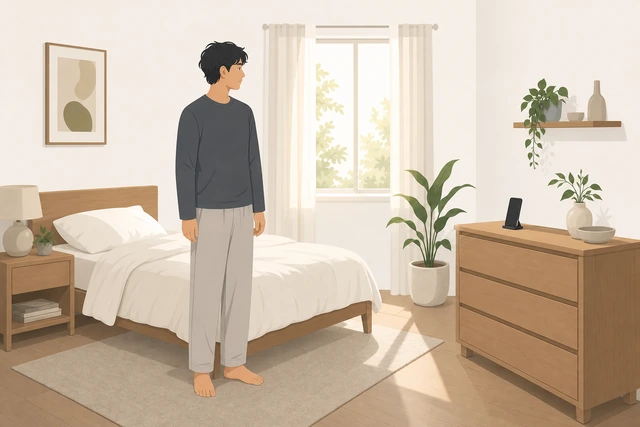
The first minute decides the morning — upright before unlock stops the bed-scroll loop.
- When the alarm rings, sit up and put both feet on the floor.
- Stand within about 60 seconds.
- Do not unlock feeds while still in bed.
You are upright with feet on the floor and the phone still locked or not in hand.
Phone already open in bed? → Phone hijack.
Do the anchor cue immediately.
Light on / water / bathroom / kettle · cue done · sequence started.
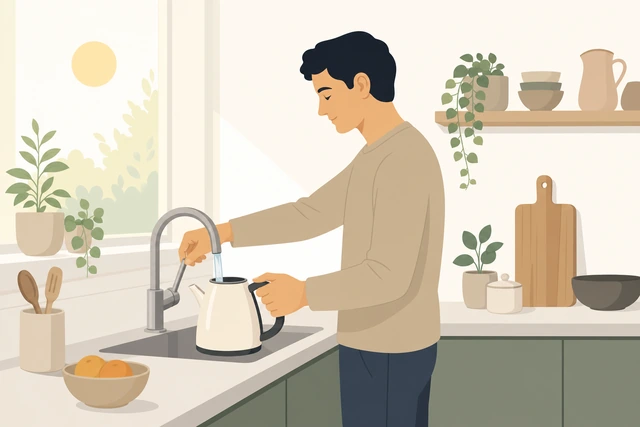
Completing the cue proves the chain started — waiting to feel ready invites a return to bed or phone.
- Do the written cue right away (light, water, bathroom, or kettle).
- Check it off mentally or on the sticky.
- Do not rearrange the list mid-stream.
The anchor cue is completed and the sequence has started.
Run actions 1–3 in written order.
Follow sticky order · check off 1 then 2 then 3 · no reshuffling.
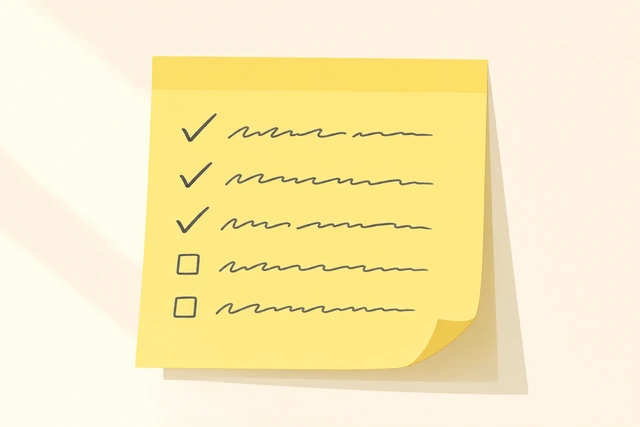
Sticking to order prevents cherry-picking the fun parts and skipping the ones that make the morning work.
- Do action 1 exactly as written, then 2, then 3.
- Mark each one done as you finish it.
- If time is already short, jump to the minimum branch instead of inventing a new plan.
Actions 1–3 are done in the written order (or you switched to the minimum).
Feel like you already blew it? → All-or-nothing.
If time is short, switch to the written minimum (2 steps).
Open minimum line · do only those two · no new plan · no shame spiral.
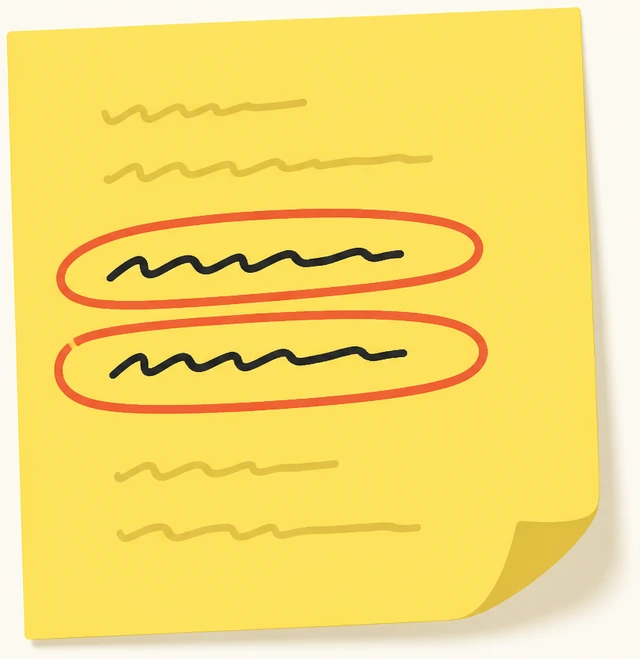
All-or-nothing mornings fail — a pre-written minimum keeps the streak alive on late starts.
- Find the two-step minimum you wrote in preflight.
- Do only those two steps.
- Do not invent a harder makeup routine for tomorrow as punishment.
The minimum is done, or the full sequence finished on time.
Tempted to skip everything? → All-or-nothing.
Keep the phone rule: unlock only after the sequence.
Sequence first · then unlock · or kitchen timer before feeds.
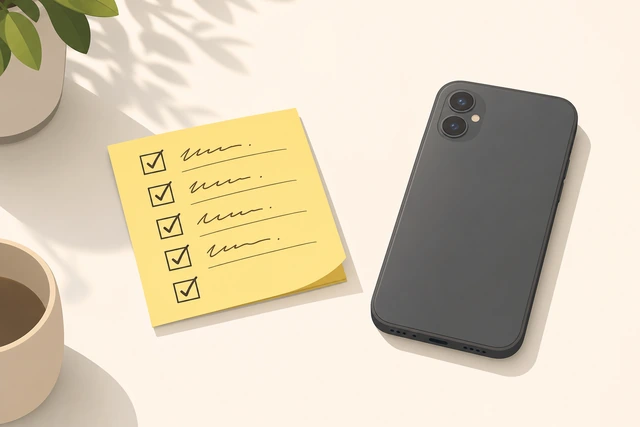
Feeds before the sequence steal the window you protected — delay unlock until the sticky is done.
- Finish the sequence (or minimum) before opening feeds.
- If you need the phone as a timer, use a kitchen timer instead when possible.
- When you unlock, do the day-start task first — not social apps.
Feeds open only after the sequence or minimum is done.
Already scrolled first? → Phone hijack.
End with one clear day-start marker.
Curtains open · coffee sit · or shoes by door · clear handoff.

A marker tells your brain the routine is complete so you do not drift back into bed or endless prep.
- Choose one end marker (open curtains, sit with coffee, put shoes by the door).
- Do that marker after the last sequence item.
- Then move into the rest of the morning on purpose.
You completed a clear handoff from routine to the rest of the morning.
Same evening: 30-second review — one tweak for tomorrow.
One line · what broke · one tweak · update sticky if needed.

Tiny reviews beat restarting from scratch — one tweak per day compounds into a routine that sticks.
- Write one line: what worked and what broke.
- Change at most one item on tomorrow's sticky.
- Keep the minimum line unless it is clearly wrong.
A one-line review is written and tomorrow's sticky is updated if needed.
Repeat for three mornings before adding anything new.
Three mornings · same sticky · no new stacks yet.
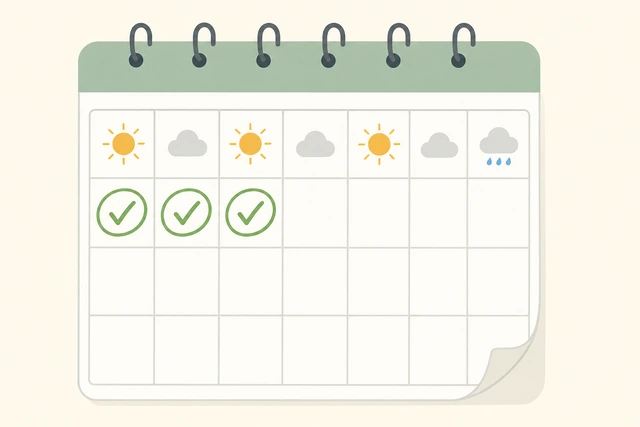
Stacking meditation, gym, and cooking before proof makes every morning feel like failure.
- Run the same sticky for three mornings.
- Do not add new habits until those three are done.
- Use the minimum on hard days instead of rewriting the whole list.
You have three mornings on the same base sequence (minimum counts).
After 3–7 days, lock the sticky as v1 — change one item at a time.
Sticky labeled v1 · stable · only one change at a time later.
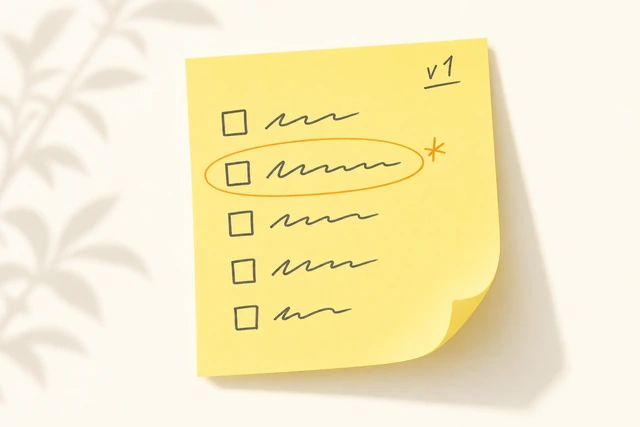
Constant redesign is procrastination — a locked v1 is what sticks looks like in real life.
- Label the working sticky as v1.
- If you change something later, change only one item.
- Keep the night-before setup and phone rule even when you tweak actions.
A stable written v1 sequence exists and changes are one-at-a-time.
Snooze trapHit snooze / stay in bed / "five more minutes" loop
Tonight: put the phone/alarm across the room.
Phone off nightstand · across room · before sleep.
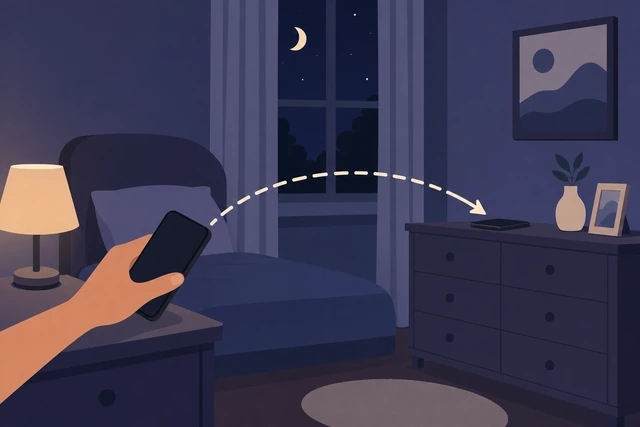
You cannot fix tomorrow's snooze loop from bed — set distance tonight.
- Move the alarm to a dresser or shelf across the room.
- Charge it there if it is your phone.
- Agree that standing comes before unlocking.
Tonight's alarm is across the room, not on the nightstand.
When it rings: sit, feet down, stand before unlock.
Sit · feet down · stand · then walk to alarm.
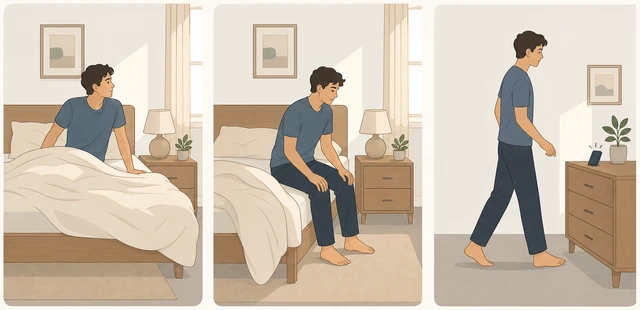
Movement first breaks the snooze identity loop before your thumb can hit it.
- Sit up as soon as it rings.
- Both feet on the floor, then stand.
- Walk to the alarm before any unlock.
You are standing at the alarm before unlocking.
Do only the written minimum (2 steps).
Minimum only · two steps · count it as a win.
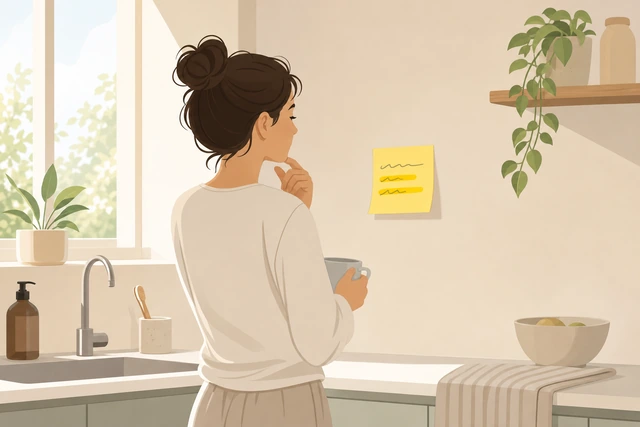
After snooze you are already late — the minimum protects the habit without a makeup marathon.
- Open the minimum line.
- Do those two steps only.
- Skip optional items without rewriting the list.
The two-step minimum is done.
If already late: cue + one action still counts.
Cue + one action · still counts · then start the day.

A tiny completed chain beats a skipped morning that trains I never do this.
- Do the anchor cue.
- Do one action from the list.
- Move into the day without a shame lecture.
Cue plus one action is complete.
At night: write "snooze cost = X minutes."
One line · minutes lost · no self-attack · plan distance again.
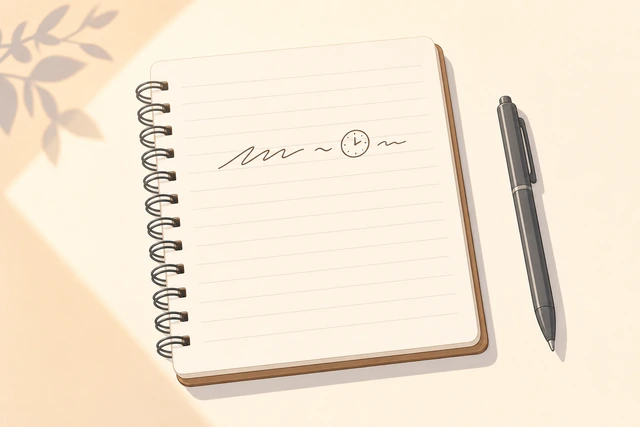
Seeing the cost in minutes motivates distance better than vague guilt.
- Estimate how many minutes snooze took.
- Write one line.
- Reset the across-room alarm for tomorrow.
Snooze cost is written and the across-room setup is restored.
Chronic exhaustion for weeks despite earlier bedtimes — check sleep debt or see a clinician; this is not sleep-disorder care.
Phone hijackUnlock "just to check" and lose 10–30 minutes before any routine step
Lock immediately — do not open feeds.
Lock now · no feeds · stop the hijack mid-reach.

The first feed tap expands the damage — locking now saves the rest of the window.
- Lock the screen right away.
- Do not open social, news, or email.
- Put the phone down on a hard surface.
The phone is locked with no feed open.
Park the phone in kitchen or bathroom until done.
Kitchen or bath shelf · out of bedroom · sequence first.
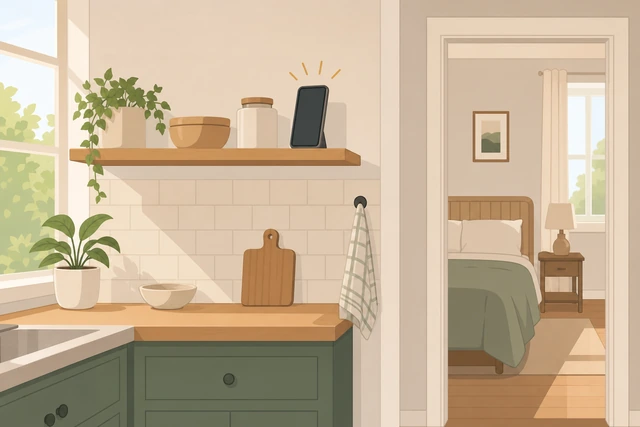
Out of the bedroom removes the bed-scroll cue for the rest of the morning.
- Carry the phone to kitchen or bathroom.
- Leave it on a shelf.
- Return to your sticky without it in hand.
Phone is parked outside easy bed reach.
Run a kitchen timer for the sequence first.
Timer on · sticky sequence · phone stays parked.
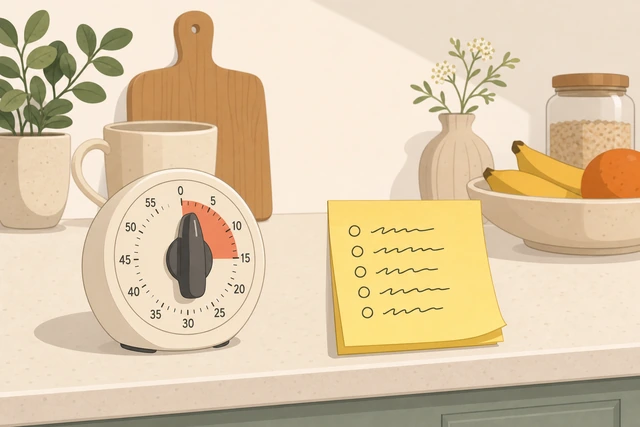
A timer makes the sequence the current job so "just one check" loses its job title.
- Start a kitchen timer for your time box.
- Follow the sticky until it ends.
- Ignore the parked phone.
Timer is running and you are on the sticky, not the phone.
If you already scrolled: run the minimum, no lecture.
Minimum done · no makeup punishment · continue the day.
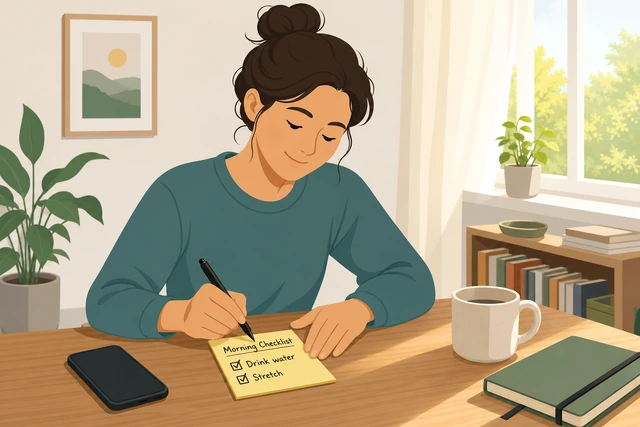
Shame spirals cause skipped tomorrows — complete the minimum and keep the habit alive.
- Do the two-step minimum.
- Skip the self-lecture.
- Do not add extra tasks as punishment.
Minimum is done after the scroll slip.
Next night: charge outside the bedroom or use a cheap alarm.
Charge elsewhere · or cheap alarm · remove unlock-from-bed.
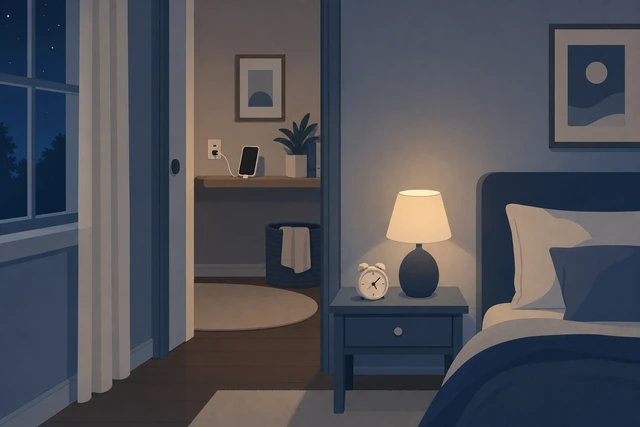
Environment beats reminders — if the phone is not beside the pillow, hijack gets harder.
- Charge the phone outside the bedroom, or buy a basic alarm clock.
- Put tomorrow's sticky where you will stand.
- Keep the after-sequence unlock rule.
Overnight setup removes easy in-bed unlock.
Panic when the phone is away, or compulsive checking most mornings — consider broader support beyond this guide.
All-or-nothingMissed one step / woke late / felt "ruined" — tempted to skip the whole routine
Open the sticky and find the minimum line.
Find minimum · ignore the full fantasy list for now.
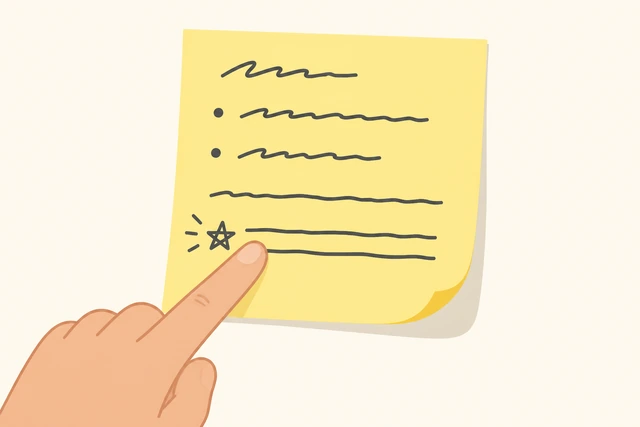
The full list is for normal days — the minimum is the tool for imperfect mornings.
- Find today's sticky.
- Locate the two-step minimum.
- Ignore optional items.
Minimum line is in front of you.
Do only those two steps.
Two steps only · check them off · stop.
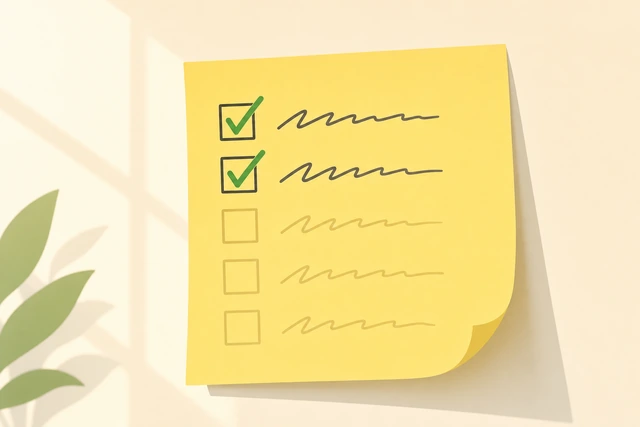
Finishing two steps rebuilds "I keep promises to myself" better than quitting.
- Do step A of the minimum.
- Do step B.
- Stop — that is enough today.
Both minimum steps are done.
Cross off "done enough" — no makeup session.
Mark done enough · no extra tasks · no self-attack.
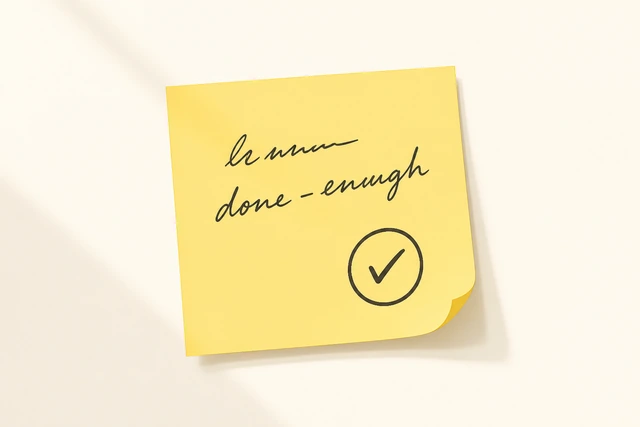
Makeup sessions teach that imperfect days require punishment — that kills stickiness.
- Write or say "done enough."
- Do not add a longer evening routine as payback.
- Move into the day.
You marked the morning done enough without a makeup load.
Keep tomorrow's list unchanged.
Same sticky tomorrow · do not harden the plan.
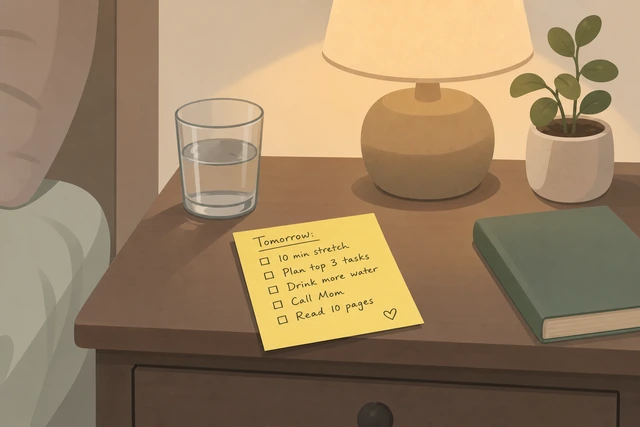
Harder plans after failure create another miss — stability is the repair.
- Leave tomorrow's sticky the same.
- Keep the same minimum.
- Only tweak after a calm evening review.
Tomorrow's list is not made harder as punishment.
Optional: move one optional item to evening.
One optional item · shift to evening · morning stays light.
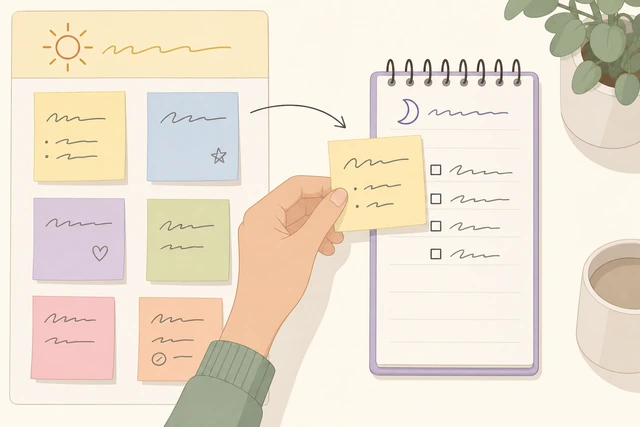
Protecting the morning list keeps it sticky; optional goals can live later.
- Pick one optional morning item.
- Write it on an evening note instead.
- Leave the morning minimum intact.
Morning list stays light; optional item has an evening home if needed.
If imperfect mornings trigger severe anxiety most days, seek appropriate support — this habit guide is not therapy.
When to get help
- Ask a housemate to place your alarm across the room tonight.
- If you cannot wake despite earlier bedtimes for weeks, talk to a doctor about sleep.
- If mornings trigger severe anxiety or despair most days, seek appropriate mental-health support.
When This Doesn't Work
- Your wake time shifts by hours on weekends. Keep the same cue and minimum; only nudge the clock within about an hour.
- You share a room and cannot move the alarm. Use a wearable vibe alarm or agree a housemate taps the light on.
- Chronic exhaustion persists for weeks. This habit plan is not sleep-disorder care — see a clinician.
- You only wrote a fantasy 12-step wellness morning. Restart at preflight and cut to 3–5 actions.
Warnings
- Do not unlock feeds in bed — stand and do the cue first.
- Do not use snooze as the plan — across-room alarm is the plan.
- Do not punish a messy morning with a harder list — run the minimum.
- This guide is not medical advice for insomnia, depression, or addiction.
Tips
- Put the sticky on the bathroom mirror or kettle — where the cue happens.
- Same wake window most days beats a perfect Saturday routine.
- If kids or caregiving blow up the morning, the minimum still counts.
- Pair with a phone-free evening so the phone is already out of the bedroom.
FAQ
How long should the routine be?
Most sticky mornings fit in 10–20 minutes. If it needs an hour, cut actions until weekdays work.
What belongs on the list?
Only actions you will actually do after a normal wake — water, light, wash, dress, short stretch, coffee. Skip fantasy stacks until v1 is stable.
Can I use my phone as the alarm?
Yes if it stays across the room and you stand before unlocking. A cheap clock is simpler if hijack is frequent.
What if I miss a day?
Run the minimum the next morning. Do not rewrite a harsher plan as punishment.
When can I add meditation or a workout?
After three proof mornings on the same sticky. Add one item at a time.


Comments
Questions, corrections, and what worked for you. Comments are reviewed before they appear.