How to Mow a Lawn
Mow a lawn evenly in about 45 minutes without scalping it or leaving missed strips. Clear the yard, mow only dry grass, set the deck with the 1/3 rule, and use overlapping straight passes with the discharge aimed away from people. Read one step at a time. Start with the preflight. Deck clogging with wet clippings? See Clogged deck. Brown or bare patches after mowing? See Scalped patches. Grass tips looking torn instead of cut clean? See Dull blade.
Tips for reading this guide
- One step at a time. Read the green caption, the Why line, then the bullets.
- Move on when the green done line is true — then go to the next step.
- Never more than a third. The 1/3 rule keeps you from scalping the lawn in one pass.
- Dry grass only. Wet grass clogs the mower and clumps on the lawn.
- Deck clogging? See Clogged deck. Brown patches? See Scalped patches. Torn, ragged grass? See Dull blade.
- Need help? Ask someone to walk the yard with you first and confirm the mower is off before anyone reaches near the deck.
Things You'll Need
- Lawn mower with a sharp, balanced blade and clean underside
- Eye protection and ear protection
- Closed-toe shoes and clothing with no loose drawstrings
- String trimmer or edger for edges and tight spots
- A stick or plastic scraper for clearing clogged clippings
- Dry weather — grass and soil dry, not right after rain or watering
- About 45 quiet minutes, more if the yard is large or overgrown
Where are you stuck?
Follow Start here for a full mow. Jump to a branch if the deck clogs, patches turn brown, or the cut looks torn.
- I need to mow the lawn from scratch Clear debris · dry grass · 1/3 rule · overlapping passes
- Deck is clogging or grass is wet Stop mower · wait or raise deck · clear clog safely
- Brown or scalped patches after mowing Raise deck · let it recover · overseed bare soil
- Grass looks torn or ragged, not cleanly cut Inspect blade · sharpen or replace · test-cut a patch
Start hereClear debris → dry grass → 1/3 rule → overlapping passes → safe discharge → clean up
Preflight — clear yard, dry grass, sharp blade and deck height checked, gear on.
Walk the yard clear · confirm dry grass · check blade with engine off · eye/ear protection ready.
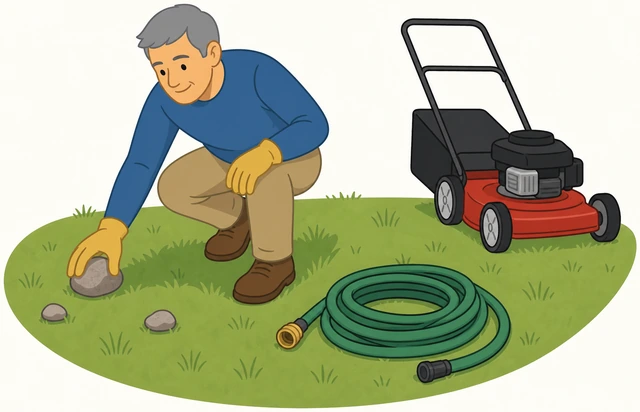
Rocks left in the grass, a dull blade, or mowing wet grass are the top causes of mower damage, ragged cuts, and injuries — checking all of it before you start prevents most problems in one pass.
- Yard clear? Walk the whole yard and pick up rocks, sticks, toys, hoses, and pet waste.
- Dry and safe? Grass and soil are dry, and the blade was checked with the engine off and spark plug pulled or battery removed.
- Geared up? Eye and ear protection, closed-toe shoes, and kids/pets called clear of the area.
The yard is walked clear, the mower was checked safely with the engine off, and you're geared up before starting.
Grass is wet from rain, dew, or a sprinkler? → Clogged deck covers what to do instead of forcing a wet cut.
Walk the entire yard and remove debris.
Full walk-through · rocks, sticks, toys, hoses, pet waste · before the mower moves.
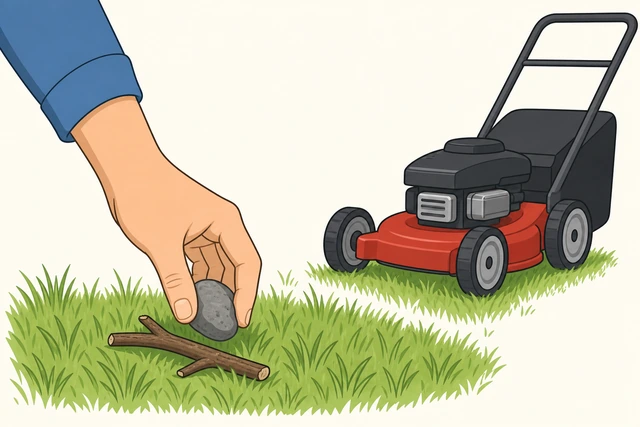
A rock or stick thrown by a spinning blade can travel fast enough to injure someone or crack a window, and hidden debris is also what dulls or bends a blade.
- Walk every part of the yard the mower will cover, not just the middle.
- Pick up rocks, sticks, toys, hoses, pinecones, and pet waste.
- Check under bushes and along fence lines where debris tends to collect.
No loose objects remain anywhere the mower will pass over.
Confirm grass and ground are dry before mowing.
Touch test · dry blades and soil · not right after rain, dew, or watering.
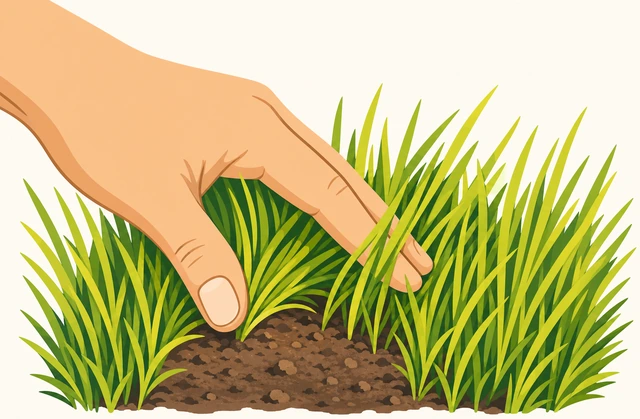
Wet grass clogs the deck and discharge chute, clumps instead of scattering, cuts unevenly, and turns the ground underfoot slippery.
- Touch the grass blades — they should feel dry, not damp or beaded with dew.
- Check the soil isn't squelchy or soaked from recent rain or a sprinkler.
- If it's wet, wait for it to dry rather than mowing through it.
Grass blades and soil both feel dry, not damp or wet.
Grass is still wet and mowing can't wait? → Clogged deck explains how to mow it safely anyway.
Measure grass height and set the deck using the 1/3 rule.
Estimate current height · set deck so this cut removes at most one-third.
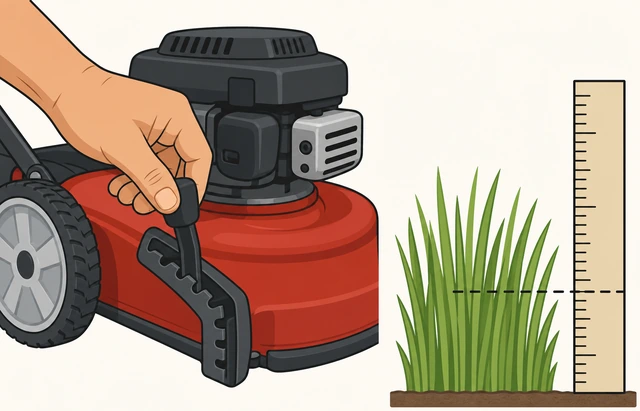
Removing more than a third of the blade length in one cut stresses the grass and is the single biggest cause of the brown, scalped-looking patches beginners run into.
- Look at how tall the grass has grown since the last mow.
- Set the deck height lever so this pass removes no more than a third of that height.
- If the grass is very overgrown, plan a higher first cut instead of dropping straight to your usual height.
The deck height is set so this cut takes off at most a third of the current grass height.
Grass is much taller than usual and you're tempted to cut it all the way down today? That's how scalping happens — see Scalped patches for the safer two-cut approach.
Inspect the blade and clean the underside with the engine off.
Engine off · spark plug disconnected or battery removed · check blade, scrape underside.
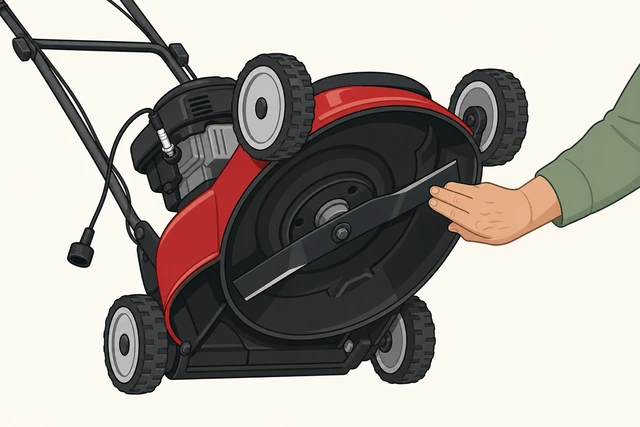
Checking the blade before you mow tells you whether today's cut will slice cleanly or tear the grass, and doing it with the engine confirmed off is what keeps this step safe.
- Turn the mower off, disconnect the spark plug, or remove the battery on electric models.
- Tip the mower as instructed in its manual and look at the blade edge for dullness, nicks, or bends.
- Scrape off any old dried clippings caked on the underside.
The blade has been checked and the underside is scraped clean, with the engine confirmed off throughout.
Never reach under the deck without confirming the engine is off, the spark plug is disconnected (or the battery removed), and the blade has fully stopped spinning. Blade already looks dull, nicked, or bent? → Dull blade.
Put on protective gear and clear the area of kids and pets.
Eye protection · ear protection · closed-toe shoes · kids and pets called inside.
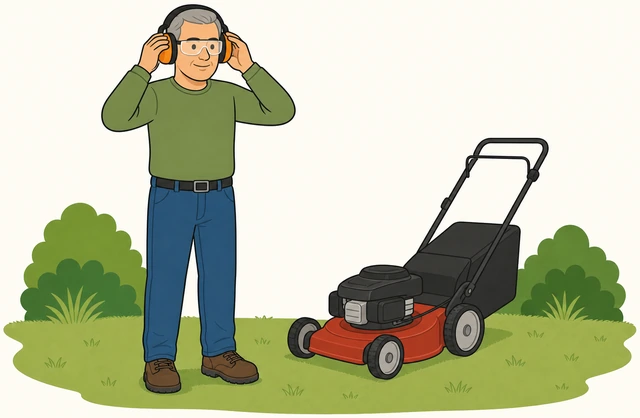
Mower noise is loud enough to cause real hearing damage over repeated exposure, and flying debris is a genuine eye-injury risk — both are avoided just by gearing up first.
- Put on eye protection and ear protection (earmuffs or plugs).
- Wear closed-toe shoes and clothing with no loose drawstrings that could catch.
- Call kids and pets inside or somewhere clearly away from the mowing area.
You're wearing eye and ear protection and closed-toe shoes, and the area is clear of children and pets.
Start the mower on flat, clear ground.
Flat clear patch · follow starting procedure · steady running before moving.
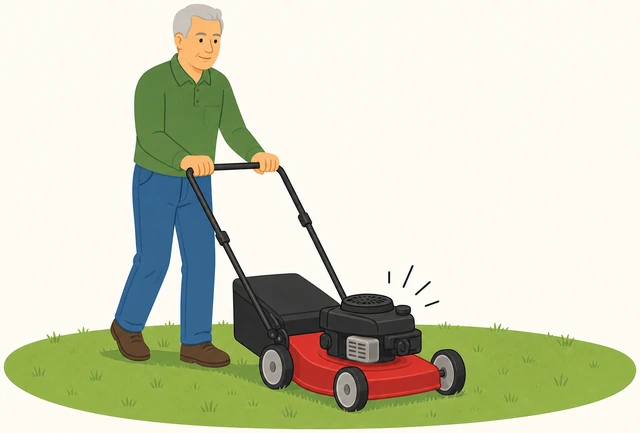
Starting on flat, open ground away from obstacles means you're not fighting for footing or bumping something the moment the engine catches.
- Position the mower on a flat, clear patch of the yard, not near obstacles.
- Follow the starting procedure for your mower (choke/primer and pull cord for gas, safety key or bar for electric).
- Let it settle into steady running before you start pushing forward.
The mower is running steadily on flat ground, and you haven't started moving yet.
Aim the discharge chute away from streets, people, pets, and windows.
Check discharge side · faces open yard · not toward hazards.
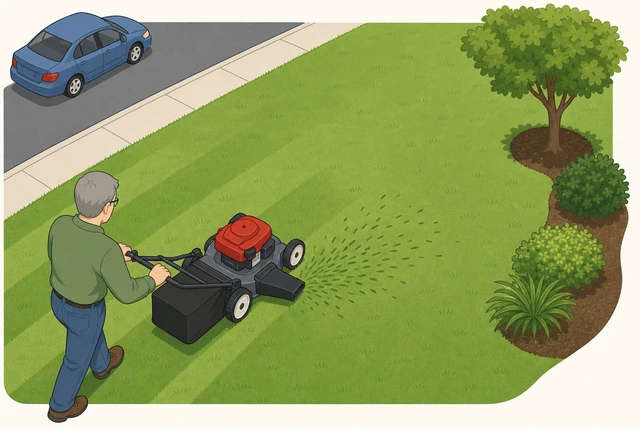
A mower can throw small rocks or sticks with real force — pointing the discharge chute at open yard instead of a street or window is what keeps a stray object from hurting someone or breaking glass.
- Look at which side of the mower the discharge chute faces.
- Position your starting point so that side faces open yard, not a street, driveway, person, pet, or window.
- Re-check this any time you turn the mower to face a new direction.
The discharge chute faces open yard for the direction you're about to mow.
Mow the first pass along a straight reference edge.
Fence, driveway, or sidewalk · straight baseline strip.
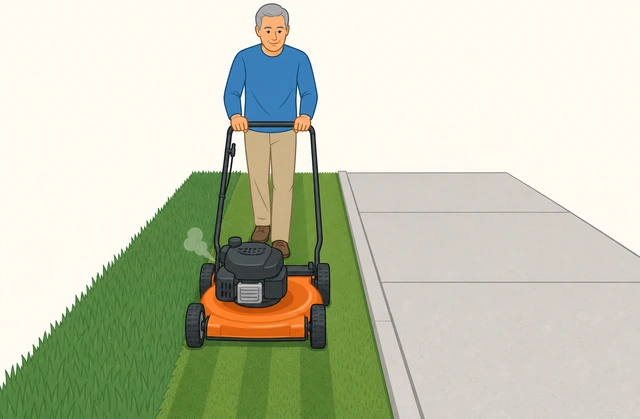
A straight first strip gives you a reliable edge to overlap against for every pass afterward, instead of drifting into curved, uneven rows.
- Pick a straight edge — a fence line, driveway, or sidewalk — to walk alongside.
- Push the mower in a straight line along that edge at a steady pace.
- Keep glancing slightly ahead, not straight down, to keep the line straight.
The first strip is cut straight along the reference edge, not curved or wandering.
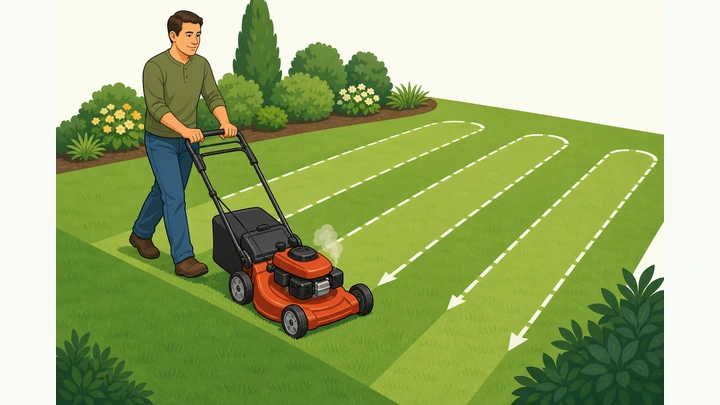
Mow the rest of the yard in overlapping straight passes.
Overlap a couple inches · steady pace · strip by strip across the yard.
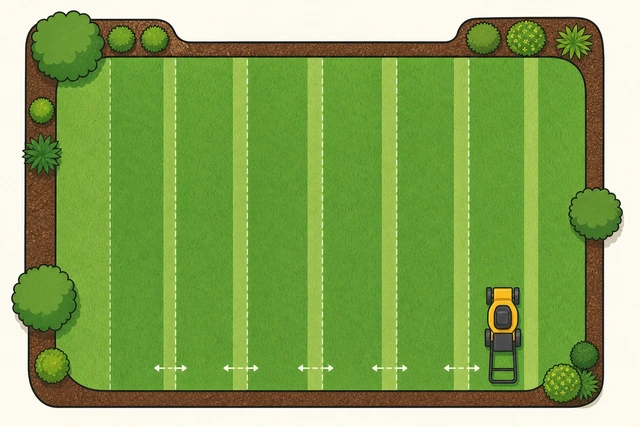
Overlapping each pass by a couple of inches is what closes the gap between strips — skip it and you're left with a thin missed line of uncut grass running across the lawn.
- Line up each new pass to overlap the previous one by a couple of inches.
- Keep a steady walking pace — rushing leaves uneven cut height.
- Work strip by strip across the whole yard, checking behind you for missed patches.
Every strip overlaps the last with no visible missed strip of uncut grass between passes.
Deck starts clogging or the mower bogs down mid-pass? → Clogged deck. Grass tips looking torn instead of cut clean? → Dull blade.
Manage clippings — mulch finely or bag before they clump.
Mulch or bag · empty before piles form · match to clipping length.
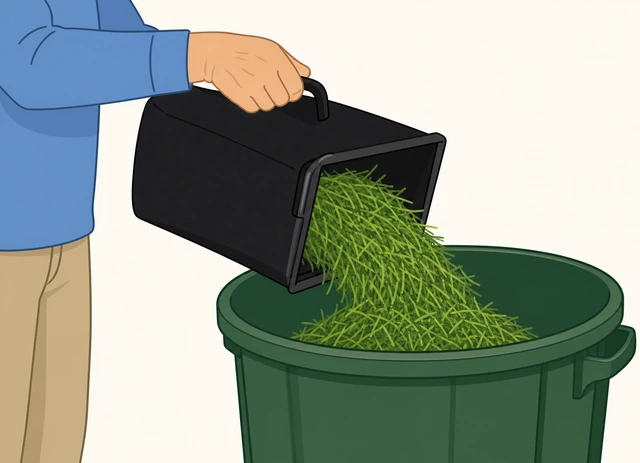
Clippings left to pile into thick clumps smother and yellow the grass underneath within days — mulching finely or bagging in time is what keeps that from happening.
- Choose mulching for short, light clippings, or bagging for longer, wetter ones.
- If bagging, empty it before it's overflowing and dragging clumps behind the mower.
- If mulching, check behind you for any clumps and go back over them if they're thick.
Clippings are dispersing finely or the bag is emptied before any clumps sit on the grass.
Vary the mowing pattern from last time.
Note today's direction · plan a different one next mow · N-S, E-W, diagonal.
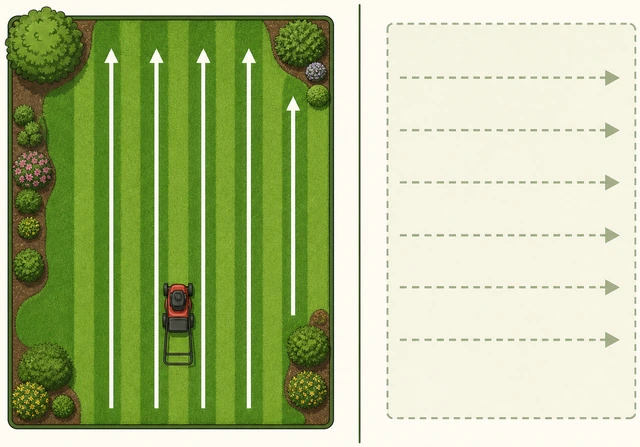
Mowing the exact same direction every time compacts soil into ruts and trains the grass to lean one way, giving a streaky, uneven-looking lawn over months.
- Notice which direction you're mowing today (north-south, east-west, or diagonal).
- Make a mental note (or a phone note) to mow a different direction next time.
- Rotate through a few patterns over your regular mowing schedule, not just two.
Today's mowing direction is noted as different from last time, or a change is planned for next mow.
On any slope, mow across it, not up and down.
Side-to-side across slope · slower pace · extra caution on hills.
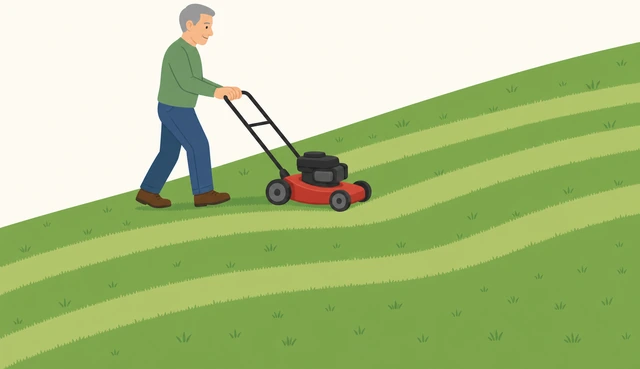
Mowing straight up and down a slope makes it much easier for a walk-behind mower — or you — to lose footing and slide compared with mowing across the slope.
- On sloped ground, walk and push the mower side-to-side across the slope.
- Slow your pace on any slope compared with flat ground.
- Skip mowing very steep slopes with a walk-behind mower — consider a trimmer instead.
Every pass on sloped ground runs side-to-side across the slope, never straight up or down it.
Trim edges and tight spots the mower can't reach.
String trimmer or edger · fence lines, tree bases, bed edges.
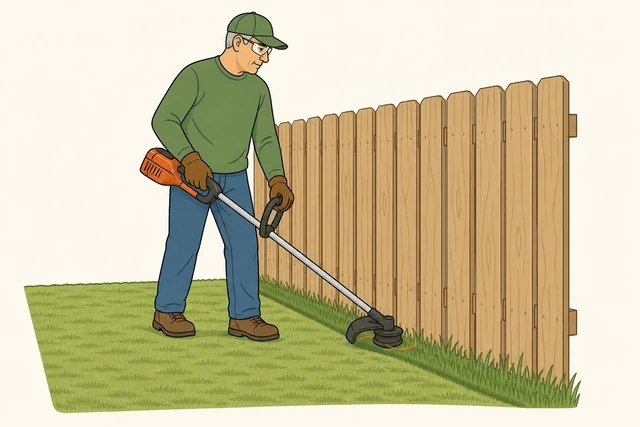
A mower deck can't reach flush against fences, tree trunks, or garden bed edges — trimming those spots is what makes the whole yard look evenly cut instead of leaving shaggy borders.
- Use a string trimmer or edger along fence lines and garden bed edges.
- Carefully trim around tree bases and posts without gouging the bark.
- Match the trimmed height as closely as you can to the mowed height.
Fence lines, tree bases, and bed edges are trimmed to match the mowed height.
Clean the mower underside and store it once cool.
Engine off, cool down · scrape underside · refuel only when cool.
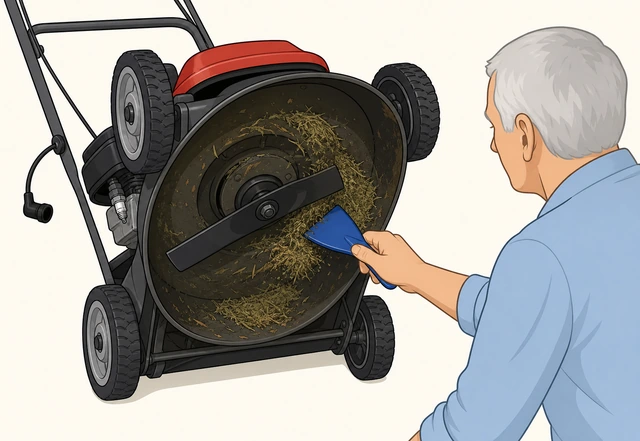
Caked-on grass left under the deck causes rust and throws off blade balance, and on gas mowers dried grass near a hot engine is a real fire risk — cleaning up after every mow prevents both.
- Shut off the mower and let the engine cool down fully.
- With the engine off and spark plug disconnected or battery removed, scrape and hose off the underside.
- Only refuel once the engine is completely cool, then store the mower.
The mower is off, the underside is cleaned, and it's stored with a fully cool engine before any refueling.
Noticing brown/scalped patches or torn-looking grass tips as you finish up? → Scalped patches or Dull blade.
Clogged deckGrass is wet or clumping, the discharge stops throwing clippings, or the mower bogs down
Stop the mower rather than forcing it through.
Release safety bar or shut off engine · don't push through a bog-down.
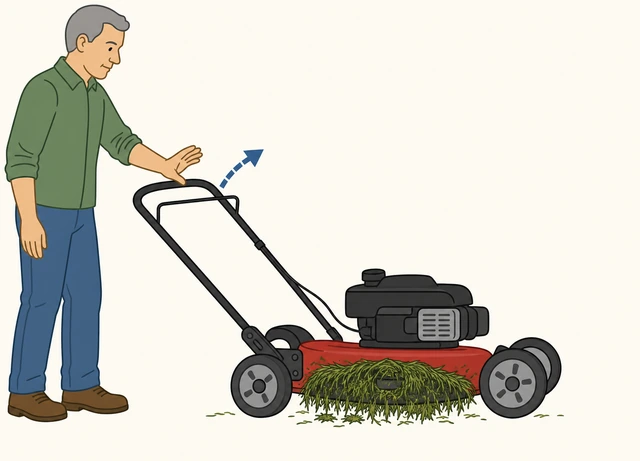
Forcing a clogged mower forward strains the engine or motor and won't clear the clog — stopping first is what actually lets you fix it safely.
- Release the safety bar or shut off the engine as soon as it bogs down or clogs.
- Don't keep pushing forward trying to force it through.
- Decide whether to wait for drier grass or continue carefully with adjustments.
The mower is stopped, not being forced through the clog.
Wait for dry grass, or raise the deck and slow down for a light first pass.
Wait if possible · otherwise raise deck height · slower pace.
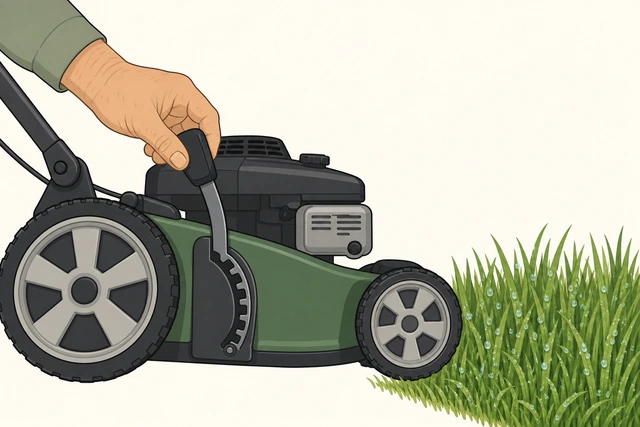
A higher, lighter first pass takes less material through the deck at once, which is what keeps wet or thick grass from clogging again right away.
- If you can wait, let the grass dry out before mowing again.
- If you can't wait, raise the deck height higher than usual for a first light pass.
- Slow your walking pace so the mower isn't overloaded with clippings at once.
You've either waited for drier grass or raised the deck and slowed down for a lighter pass.
Clear clogged clippings safely with the engine off.
Engine off, spark plug disconnected/battery removed · stick or scraper, never hands.
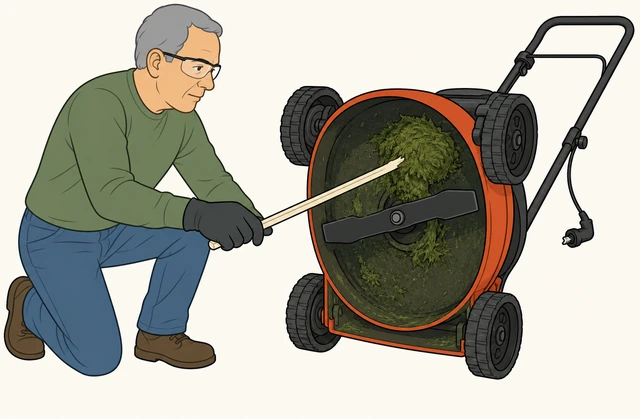
A blade doesn't stop the instant the engine shuts off, so clearing a clog with bare hands — even with the engine 'off' — is one of the most common serious mower injuries.
- Shut off the engine, disconnect the spark plug, or remove the battery.
- Use a stick or plastic scraper to clear clumped clippings from the deck and chute.
- Never use your hands near the deck, even if you believe the blade has stopped.
The clog is cleared using a stick or scraper, with the engine confirmed off the whole time.
Finish with a second, lower pass once the grass has opened up.
Light pass first · second lower pass · recheck for clumping.
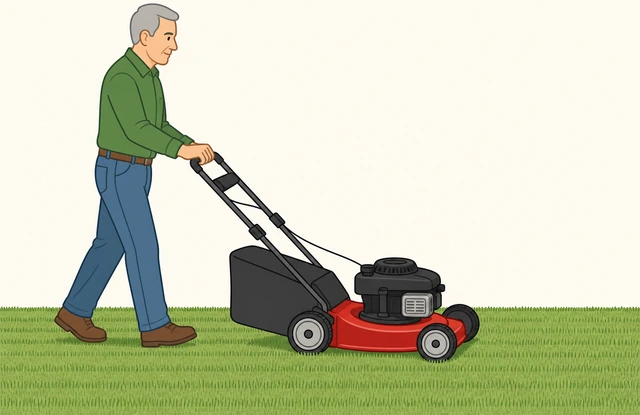
A two-pass approach — light first, then a normal lower pass — cuts wet or thick grass down gradually instead of overloading the deck in one go.
- After the first light pass, check the lawn for clumps and clear any left behind.
- Mow a second pass at your normal height once the grass is shorter and less dense.
- Watch for clogging again and repeat the light-pass approach if needed.
The lawn is fully mowed at normal height using light-then-normal passes, without repeated clogging.
Scalped patchesBrown, yellow, or bare-soil patches appear after mowing, especially on high spots or where the deck sat too low
Stop and raise the deck height for future cuts.
Stop that section now · raise deck height going forward.
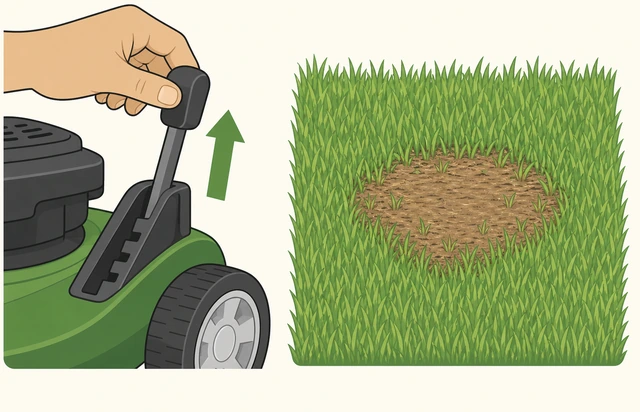
Continuing to mow at the same low height just scalps more of the lawn — raising the deck now is what stops the damage from spreading.
- Stop mowing that section at the current height right away.
- Raise the deck height lever before mowing any more of the lawn.
- Recheck the 1/3 rule against the current grass height before continuing.
The deck is raised and you've stopped mowing the affected area at the old, too-low height.
Let the grass recover before mowing that patch again.
Skip mowing that spot · water without over-fertilizing · give it time.
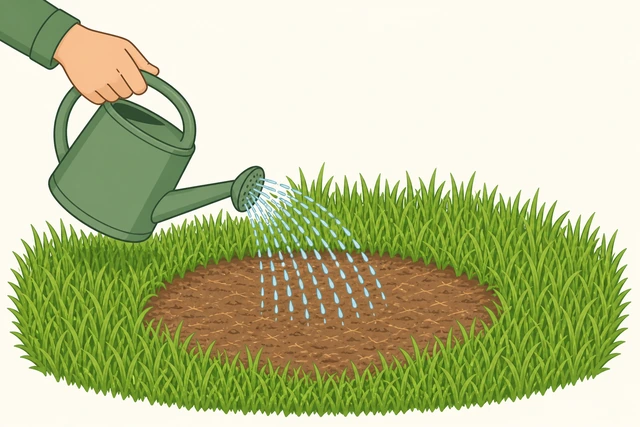
Mowing already-stressed grass again right away just adds more damage — giving it a break and steady watering is what lets the roots recover.
- Skip mowing the scalped patch again until it visibly recovers.
- Water it consistently, but avoid heavy fertilizing that could burn stressed grass.
- Keep foot traffic light on that area while it heals.
The scalped patch has been left unmowed and watered, with no fertilizer burn added on top.
Overseed any bare soil and keep it consistently moist.
Overseed exposed dirt · moist (not soaked) · until new grass sprouts.
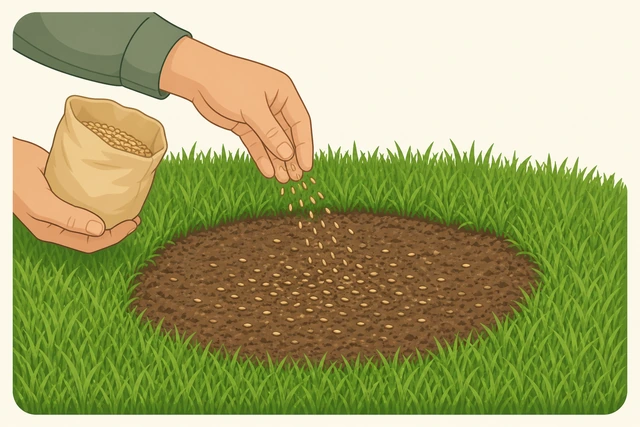
Bare soil left exposed invites weeds to take over first — overseeding while it's freshly bare gives grass the head start instead.
- Spread grass seed matched to your lawn type over any bare, scalped soil.
- Keep the seeded area consistently moist, not soaked, until it germinates.
- Keep mowing traffic off the seeded patch until the new grass is established.
Bare soil is overseeded and kept consistently moist until new grass is visibly growing.
Recheck deck height and ground evenness going forward.
Confirm 1/3 rule · check for uneven ground or wheel mismatch.
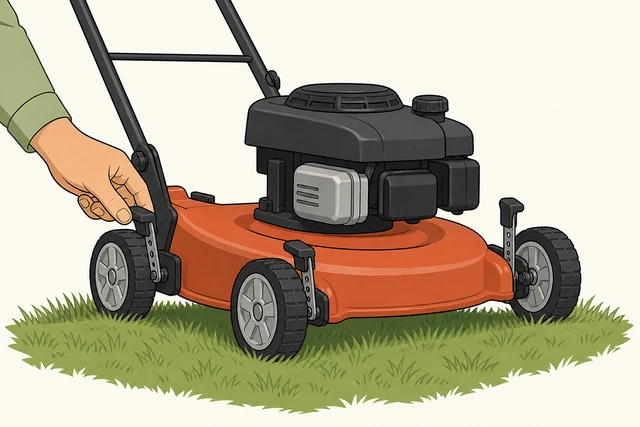
Scalping often repeats on the same high spots — checking for uneven ground or a wheel-height mismatch is what stops it from happening again next mow.
- Confirm the deck height follows the 1/3 rule for the current grass height each time.
- Check whether high spots or dips in the ground let the blade dip lower there.
- Check that all four wheels are set to the same height.
Deck height is confirmed correct and any uneven ground or wheel-height mismatch has been checked.
More than about a third of the lawn is scalped or bare, or brown patches keep appearing unrelated to cutting height? That points to disease, grubs, or a renovation job — worth a lawn-care professional's opinion instead of more mowing adjustments.
Dull bladeGrass tips look ragged, torn, or whitish-brown within a day or two instead of a clean green cut
Stop mowing and inspect the blade with the engine off.
Engine off, spark plug disconnected/battery removed · check edge for dullness, nicks, bends.
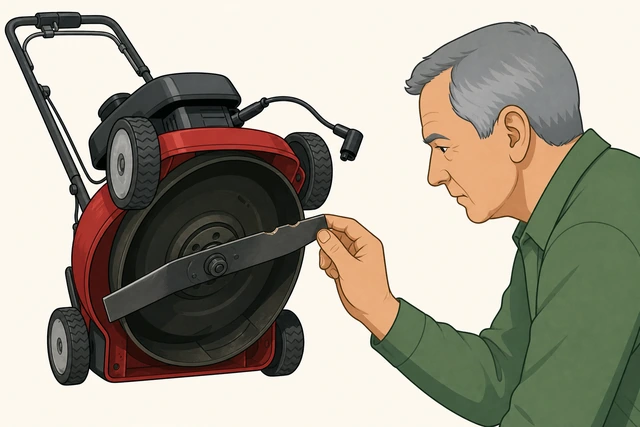
A torn, ragged cut almost always means the blade edge is dull, nicked, or bent — checking it confirms the cause before you spend time sharpening or swap parts unnecessarily.
- Shut off the mower, disconnect the spark plug, or remove the battery.
- Tip the mower as instructed in its manual and look closely at the blade edge.
- Check for dullness, small nicks, or a visibly bent edge along the blade.
The blade has been inspected with the engine confirmed off, and you know whether it's dull, nicked, or bent.
Sharpen or replace the blade, then balance it.
File, grind, or shop-sharpen · or replace if damaged · balance afterward.
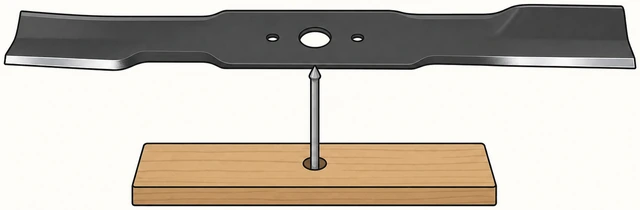
A sharpened blade that isn't balanced afterward can vibrate and wear out the mower faster — balancing is a quick check that's easy to skip but shouldn't be.
- Sharpen a dull-but-straight blade yourself with a file or bench grinder, or take it to a small-engine shop.
- Replace the blade instead of sharpening if it's cracked, chipped, or clearly bent.
- Check the blade balances level on a nail or blade balancer before reinstalling.
The blade is sharpened or replaced, and confirmed balanced before going back on the mower.
Reinstall properly and test-cut a small patch first.
Correct torque · test small patch · confirm clean cut before full lawn.
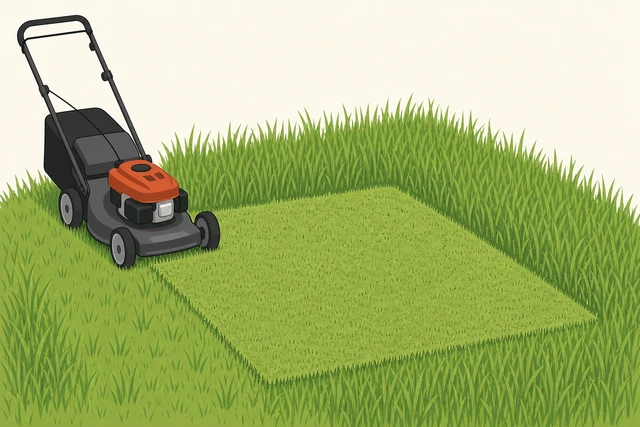
A loose or improperly torqued blade can work its way off during mowing — a quick test patch also confirms the fix worked before you commit to cutting the whole yard.
- Reinstall the blade at the torque specified in your mower's manual.
- Test-cut a small, easy-to-see patch of lawn before mowing everywhere.
- Check that patch for a clean, even cut instead of torn or ragged tips.
The blade is reinstalled at the correct torque and a test patch shows a clean, even cut.
Blade is visibly bent, cracked, or chipped? Replace it rather than sharpen it. Not confident balancing or torquing it back on yourself? Have a small-engine shop handle it instead.
When to get help
- Ask someone to double-check the mower is off and the blade has stopped before anyone reaches near the deck.
- More than about a third of the lawn scalped, or brown patches unrelated to cutting height? That's likely disease or grubs — get a lawn-care professional's opinion.
- Blade visibly bent, cracked, or chipped? Replace it rather than sharpen it, and have a shop handle balancing if you're not confident doing it yourself.
- Very steep slopes? Skip the walk-behind mower and use a string trimmer or a specialized slope mower instead.
- Mower repeatedly stalls, won't restart, or smells like burning? Stop and have it serviced rather than continuing to force it through.
When This Doesn't Work
- Very steep slopes. A walk-behind mower can lose traction and slide even mowed across the slope — use a string trimmer or a specialized slope mower instead.
- Newly seeded or sodded lawn. Wait until the manufacturer or seed package's recommended height before the first mow; cutting too soon can uproot new grass.
- Frost-covered grass. Mowing frozen grass blades bruises and damages them — wait until frost has fully melted.
- Drought-stressed, dormant lawn. Raise the deck and mow less often; a stressed lawn scalps and browns even more easily than usual.
- Electric or robotic mower with different controls. Follow your specific model's manual for starting, blade safety, and discharge — this guide's sequence is the general routine, not model-specific steps.
Warnings
- Never reach under the deck without confirming the engine is off and the blade has fully stopped. A blade keeps spinning briefly after the engine shuts off.
- Never mow with the discharge chute aimed at people, pets, streets, or windows. Thrown debris can injure someone or break glass.
- Never refuel a hot engine. Let it cool completely first to avoid a fire or burn hazard.
- Never remove more than a third of the grass blade in one cut. That's the 1/3 rule — skipping it scalps the lawn.
- Skip eye and ear protection at your own risk — mower noise and flying debris cause real, cumulative damage.
- Never mow wet grass if it can be avoided — it clogs the deck and is a slip hazard underfoot.
Tips
- Say it out loud: dry grass, sharp blade, one-third rule — every single mow.
- Change your mowing direction or pattern every time to avoid ruts and leaning grass.
- Keep a stick or plastic scraper with your mower for clearing clogs without using your hands.
- Sharpen the blade at least once a season, more often if the lawn has rocks or sandy soil.
- Trim edges either right before or right after mowing so the whole yard reads as evenly cut.
FAQ
What exactly is the 1/3 rule?
Never remove more than a third of the grass blade's height in a single mow. If the grass is 6 inches tall, don't cut it shorter than 4 inches in one pass — mow again a few days later to bring it down further.
Why can't I mow right after it rains?
Wet grass clumps and clogs the mower deck instead of scattering cleanly, cuts unevenly, and can spread fungal disease between blades of grass. Wait until it's dry.
Which direction should I mow in?
Any straight, overlapping pattern works, but change the direction each time you mow — rotating between north-south, east-west, and diagonal keeps the soil from compacting into ruts and the grass from leaning one way.
How do I know if my blade is dull?
Look at the grass a day or two after mowing. A sharp blade leaves a clean, even, green cut. A dull blade leaves ragged, torn tips that turn whitish-brown quickly. See the dull-blade branch for how to check and fix it.
I mowed too low and now have brown patches — did I kill the lawn?
Probably not permanently. See the scalped-patches branch — raise the deck, let the grass recover without mowing it again right away, and overseed any bare soil. Only very large scalped areas or unrelated brown patches need a lawn-care professional.


Comments
Questions, corrections, and what worked for you. Comments are reviewed before they appear.