How to Fold a Fitted Sheet
Fold a fitted sheet into a compact rectangle in about 10 quiet minutes — no lumpy ball. Work on a flat surface with a fully dry sheet, turn it inside-out, tuck corners into each other, lay flat, then fold to shelf width. Read one step at a time. Start with the preflight. Bundle still bulky after tucking? See still bulky. Corners slip out? See worn elastic.
Tips for reading this guide
- One step at a time. Read the green caption, the Why line, then the bullets.
- Move on when the green done line is true — then go to the next step.
- Dry sheet only. Damp elastic grips itself — corners will not tuck until the sheet is fully dry.
- Inside-out first. The elastic edge must face out so you can find the corner pockets.
- Still lumpy or corners slip out? Jump to the matching branch below.
- Need a helper? Ask someone you trust to hold opposite corners while you tuck, or smooth the flat lay on a large king sheet.
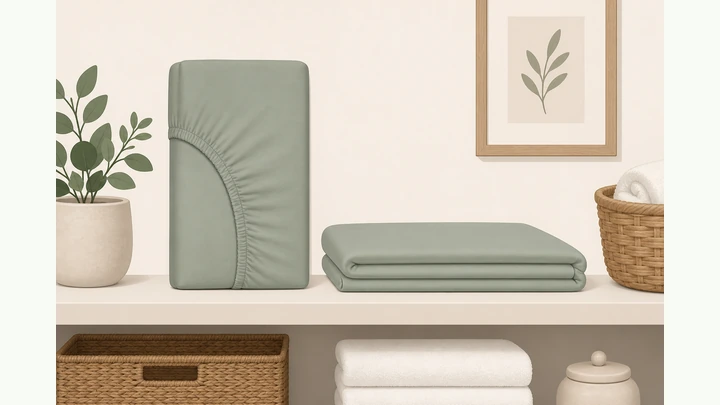
Things You'll Need
- One clean, fully dry fitted sheet — any size (twin, full, queen, or king)
- Flat surface with room to spread the sheet arms-wide — bed, dining table, or clean floor
- Linen shelf, basket, or closet shelf to store the finished fold
- About 10 quiet minutes; king sheets may need a bed for enough spread room
Where are you stuck?
Follow Start here for the full corner-tuck fold. Jump to a branch if the bundle stays bulky after tucking, or corners slip out from worn elastic.
Start hereFlat surface → inside-out → find corners → tuck long-side pair → tuck front → tuck back → lay rectangle → smooth → lengthwise fold → width fold → shelf
Preflight — flat surface, dry sheet, and clear space before any folding.
Flat bed/table/floor · sheet fully dry · arms-wide spread room.
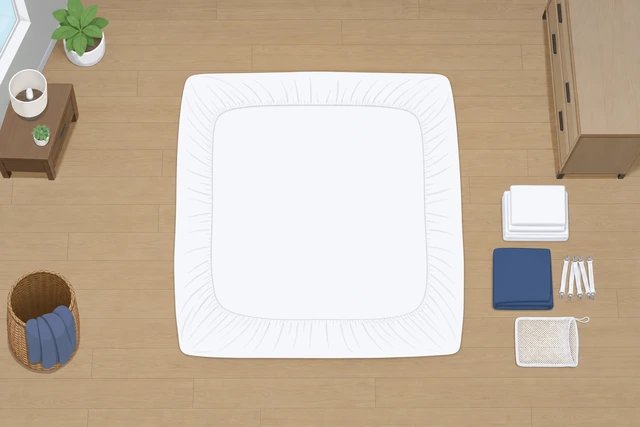
Damp elastic grips itself and corners will not slide together; a cramped surface tangles corners before the first tuck — both make the method feel broken when setup is the real problem.
- Surface flat and clean? Use a bed, table, or clean floor with room to spread the sheet arms-wide.
- Sheet fully dry? Pull from the dryer or let air-dry completely — no damp elastic.
- Space cleared? Move clutter so you can walk around the sheet edge.
You have a flat clean surface, a fully dry sheet, and enough room to spread it arms-wide.
Fold only when the sheet is fully dry — damp elastic grips itself and corners will not slide into each other, which makes the tuck method feel impossible. Corners already slip when you make the bed? See Worn elastic.
Spread the sheet inside-out on the flat surface.
Lay flat · inside-out · elastic edge up · tag in a corner pocket.
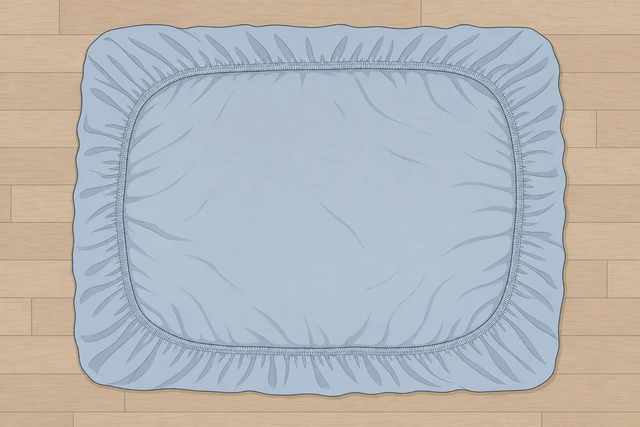
Right-side-out hides the corner pockets behind smooth fabric — inside-out puts the elastic seam where your fingers can find each pocket on the first try.
- Spread the fitted sheet flat on your surface.
- Turn it inside-out so the elastic band faces up and out.
- Check that a corner tag sits inside a corner pocket — confirms orientation.
Sheet lies flat, inside-out, with the elastic edge visible.
Stand at the long side and locate all four corner pockets.
Long edge facing you · point to each elastic corner pocket.
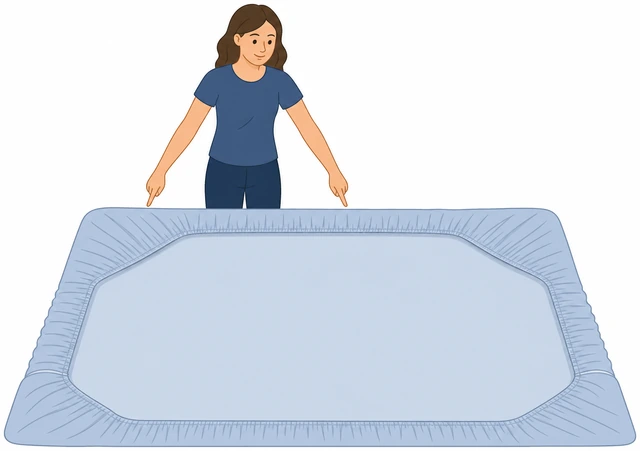
Starting on the short edge leaves dangling corners uneven — the long-side-first sequence is what keeps the final rectangle symmetrical.
- Stand at one long edge of the sheet with it spread flat.
- Find each of the four elastic corner pockets along the edge.
- Confirm you can see where the seam meets the elastic at every corner.
You can point to all four corner pockets from the long side.
Slip your left hand into one long-side corner pocket.
Left hand · one long-side corner · fingers to the seam.
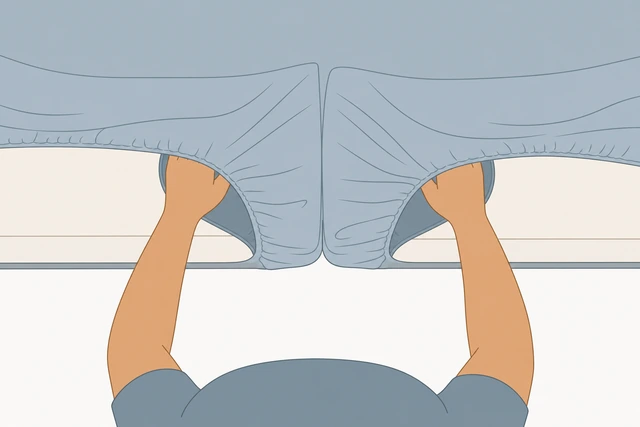
Grabbing loose fabric instead of the pocket seam makes the tuck collapse — your fingers must reach the corner seam inside the elastic pocket.
- Choose one corner pocket on the long edge nearest you.
- Slip your left hand inside the pocket with fingers reaching the seam.
- Hold the corner up at about waist height.
Left hand is inside one long-side corner pocket, fingers at the seam.
Slip your right hand into the adjacent long-side corner pocket.
Right hand · neighboring corner on same long edge · both corners up.
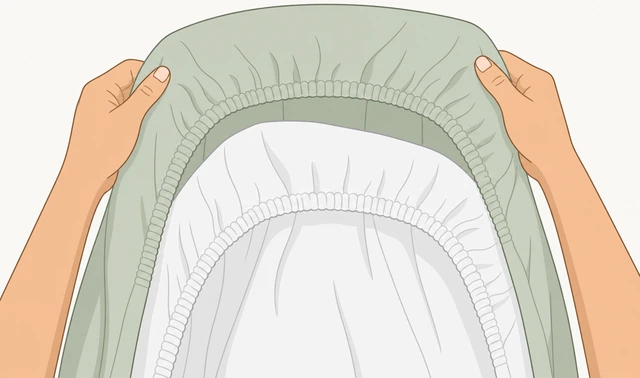
Both adjacent long-side corners must be in your hands before the first tuck — skipping one leaves three loose corners that cannot nest cleanly.
- Move to the neighboring corner pocket on the same long edge.
- Slip your right hand inside with fingers reaching the seam.
- Hold both corners up, one in each hand.
Both hands are in the two adjacent long-side corner pockets.
Bring your right hand over to your left and tuck the right corner into the left.
Right over left · nest right pocket inside left · one hand holds the pair.
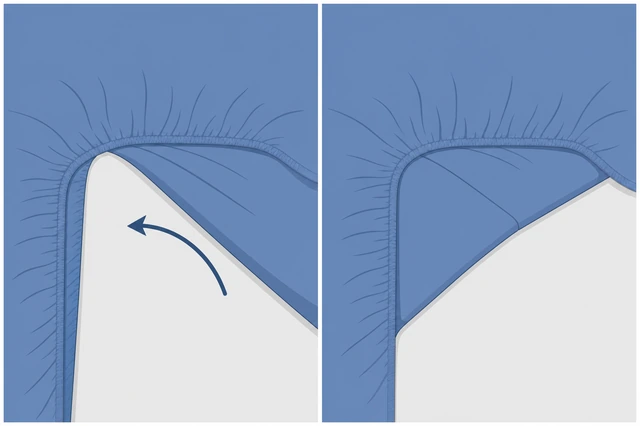
The first tuck locks the long-side pair together — without nesting right into left, the dangling corners have nothing stable to fold into.
- Bring your right hand over to meet your left hand.
- Tuck the right corner pocket inside the left corner pocket.
- Let your left hand hold the nested pair; right hand is free.
Right corner is nested inside left; one hand holds the pair.
Tuck will not nest on first try? → Still bulky.
Pick up the loose front corner and tuck it into the nested pair.
Front corner hanging down · tuck into pair · three corners nested.
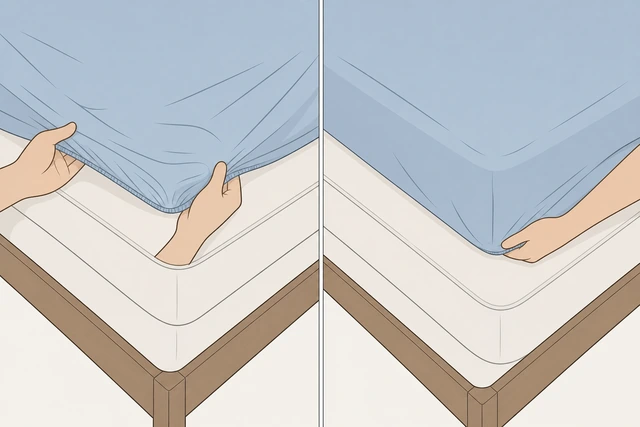
The front corner hangs loose after the long-side tuck — leaving it out is the most common reason the bundle stays round instead of flattening into a rectangle.
- Find the front corner hanging down toward the floor.
- Pick it up with your free right hand, fingers to the seam.
- Tuck it into the nested pair your left hand holds.
Front corner is tucked in; three corners are nested together.
Pick up the remaining back corner and tuck it into the stack.
Last corner · tuck into stack · all four corners nested.
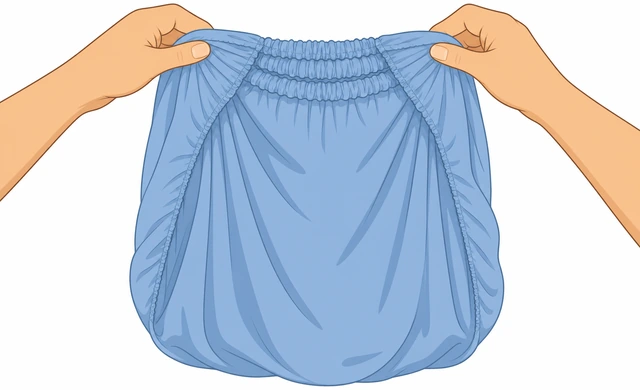
The back corner is the last loose elastic edge — once it is nested, every corner pocket is inside the stack and the sheet can lay flat.
- Reach for the remaining back corner with your free hand.
- Pick it up, fingers to the seam.
- Tuck it into the stack so all four corner pockets are nested.
All four corner pockets are nested inside one stack.
Corners slip out as soon as you let go? The elastic may be worn — jump to Worn elastic for a flat-fold method instead of corner tucking.
Lay the nested bundle flat on the surface.
Place on surface · elastic traces a rectangle · not a round ball.
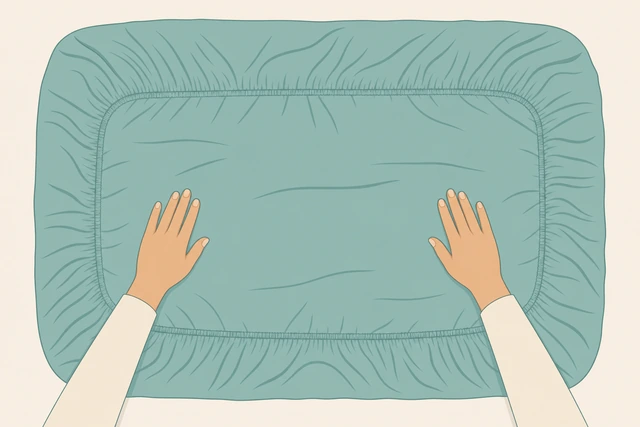
Folding in the air while still holding a wad is why readers end up with a lumpy ball — laying flat lets gravity square the elastic edge into a rectangle.
- Place the nested bundle flat on the bed or table.
- Let the elastic edge spread into a rectangle shape.
- Adjust so the bundle is not round or bunched in the center.
Bundle lies flat on the surface; elastic edge forms a rectangle, not a ball.
Still lumpy or round instead of a rectangle? → Still bulky.
Smooth wrinkles and square the rectangle.
Palms flat · smooth top · align sides · elastic band down.
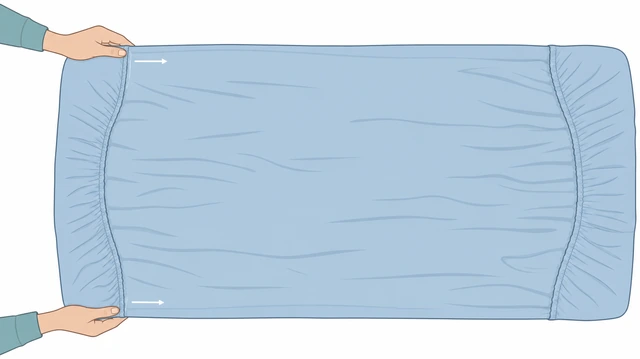
Wrinkles trapped inside a fold become permanent bumps on the shelf — smoothing now takes ten seconds and saves a lumpy stack later.
- Press the top flat with both palms.
- Smooth out wrinkles working from center to edges.
- Align the sides so the rectangle is even and square.
Top surface is smooth and sides are even; elastic band faces down.
Fold the rectangle in half lengthwise.
Long edges together · one lengthwise fold · edges matched.
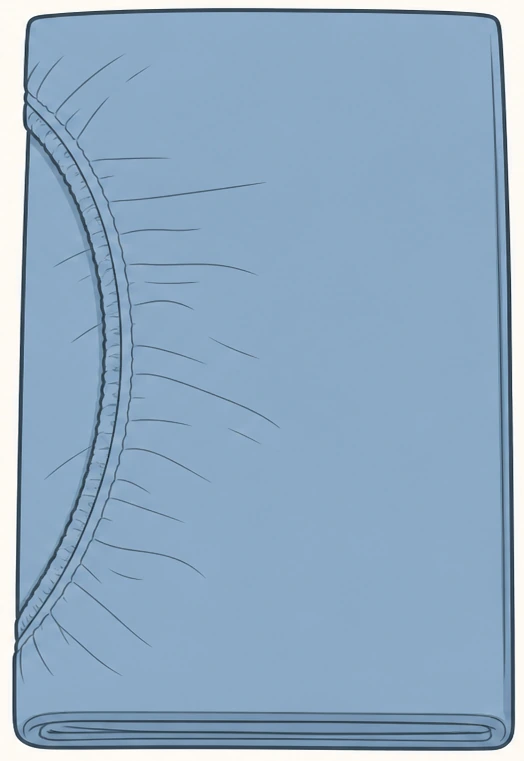
Lengthwise first keeps the elastic tucked inside the fold so it does not bulge out the sides when you store the bundle.
- Bring the two long edges together.
- Fold the rectangle in half along the length.
- Match edges as you fold so sides stay even.
One lengthwise fold is done with long edges aligned.
Fold in thirds widthwise to shelf width.
Thirds on queen/king · half-then-half on twin · fits shelf opening.
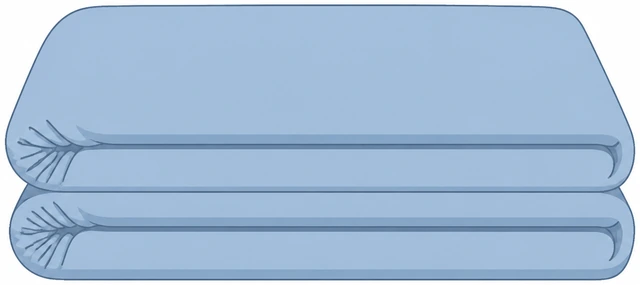
One width fold often leaves a bundle too wide to stand on edge — thirds (or two halves on a twin) match typical linen-shelf depth.
- Fold the width in thirds for queen or king, or half-then-half for a twin.
- Check the width against your shelf or basket opening.
- Add one more fold if the bundle is still wider than the shelf.
Width matches your shelf or basket opening.
Press flat, stand on edge, and place on the shelf.
Press flat · stand on edge · folded edge facing out on shelf.
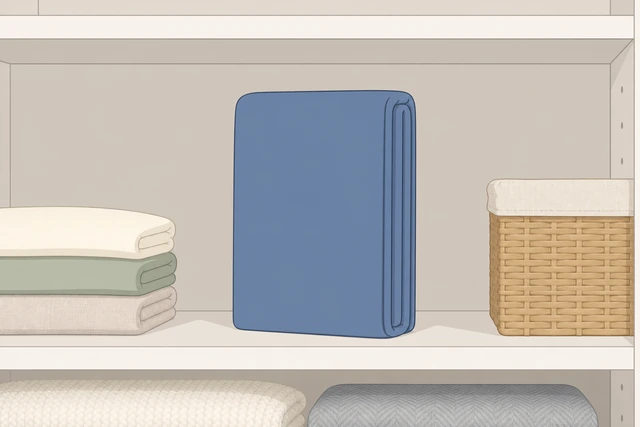
Standing the bundle on edge with the fold facing out lets you grab one set without disturbing the stack and shows size at a glance.
- Press the bundle flat with both palms.
- Stand it on edge — it should stay without springing open.
- Place on the shelf with the folded edge facing out.
Compact bundle stands on edge on the shelf with the fold edge visible.
Still bulkyNested bundle stays lumpy, round, or will not lay flat as a rectangle after corner tucking
Shake the sheet out flat and restart the corner tuck from Step 3.
Inside-out · spread flat · redo long-side tuck · snap each corner flat.
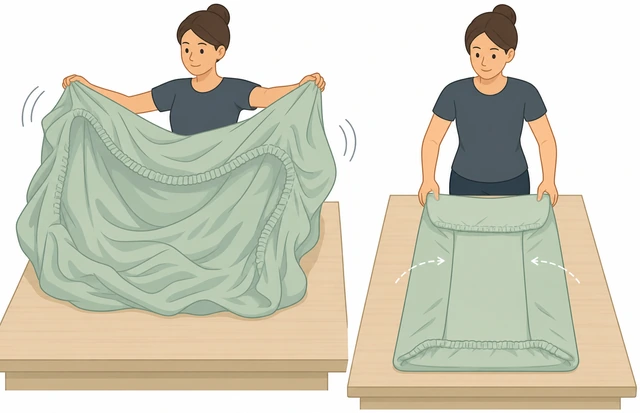
A half-tucked corner leaves fabric bunched inside the stack — restarting from a full flat spread is faster than fighting a wad that was never fully nested.
- Shake the sheet out flat on the bed, inside-out.
- Restart from Step 3 — hands in adjacent long-side corners.
- Check each tuck snaps flat before picking up the next corner.
Sheet is spread flat inside-out and corner tuck has been restarted with each tuck snapping flat.
Smooth flat and fold opposite corners to center before lengthwise fold.
Bundle flat on bed · palms smooth · opposite corners to center · envelope square.
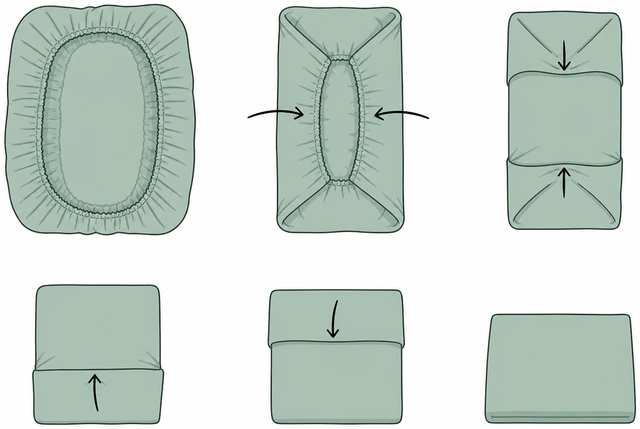
When corner tuck alone will not square the bundle, the envelope fold pulls loose elastic toward the center so the rectangle forms even if one tuck was imperfect.
- Lay the bundle flat and smooth with both palms.
- Fold opposite corners toward the center like an envelope.
- Then do the lengthwise and width folds from Step 10.
Bundle is squared with an envelope fold and ready for lengthwise and width folds.
Still will not lie flat as a rectangle after two full restarts? Corners may be slipping — try Worn elastic or replace the sheet if elastic is shot.
Worn elasticElastic is loose, corners slip out when tucking, or corner pockets will not stay nested
Skip corner tuck — lay the sheet flat elastic-side up and smooth.
Flat on bed · elastic up · smooth wrinkles · no corner nesting.
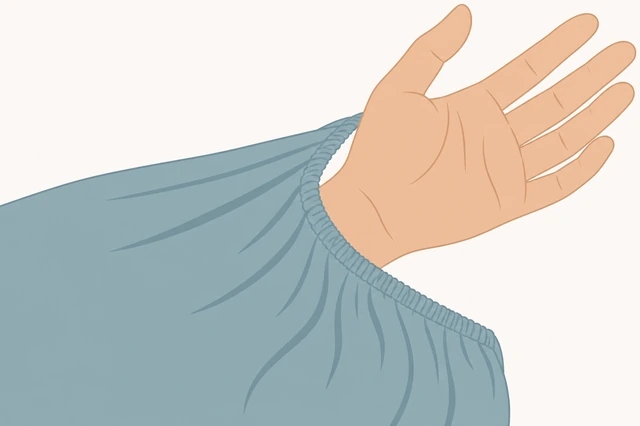
Worn elastic cannot hold a corner tuck — fighting the tuck wastes time when a flat-fold from elastic-side-up works on sheets with dead stretch.
- Lay the sheet flat on the bed with the elastic edge facing up.
- Smooth wrinkles with both palms from center to edges.
- Do not attempt corner tucking — go straight to flat folds.
Sheet lies flat elastic-side up with wrinkles smoothed.
Fold in half, half again, then tri-fold or roll to shelf width.
Short edges together · fold half again · tri-fold or roll · shelf width.
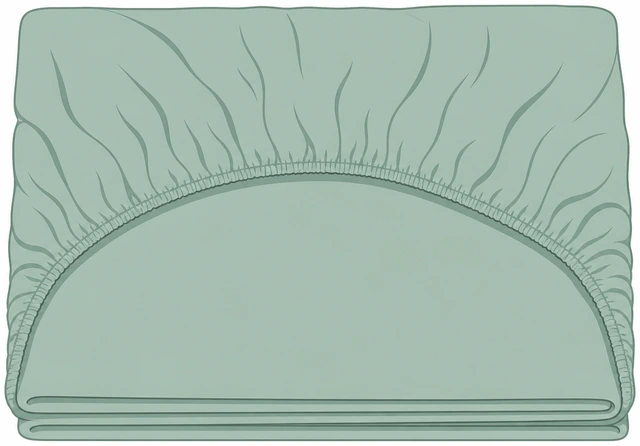
The flat-fold envelope method stacks worn sheets without relying on elastic grip — tri-fold or roll keeps loose corners contained inside the bundle.
- Fold in half bringing short edges together.
- Fold in half again.
- Tri-fold width or roll tightly to your shelf width.
Sheet is folded flat without corner tuck and fits shelf width.
Elastic no longer grips the mattress when making the bed? The sheet is worn out — replace it; folding tricks will not restore dead elastic.
When to get help
- Ask someone you trust to hold opposite corners on a large king sheet while you tuck — especially if reaching strains your shoulders.
- Bundle still will not lie flat after two full corner-tuck restarts and the envelope fold? Try the worn-elastic flat-fold branch.
- Elastic no longer grips the mattress when making the bed? Replace the sheet — folding will not restore dead elastic.
- Physical limits reaching floor-level corners? Fold on a raised bed surface or ask a helper for the last tuck.
When This Doesn't Work
- Sheet is still damp from the washer or line. Wait until fully dry — damp elastic grips itself and corners will not tuck.
- King sheet on a small table with no room to spread. Move to a bed or clean floor with arms-wide space before starting.
- Corners slip out every time you release them. Elastic is likely worn — see Worn elastic or plan to replace the sheet.
- Bundle stays round after two full corner-tuck restarts. Try the envelope squaring in Still bulky, then the flat-fold branch if elastic will not hold.
- Deep pocket or extra-deep fitted sheet. Same tuck method works but may need the bed for spread room — do not force tucks on a cramped surface.
- Sheet is balled up wet in the hamper. Wash and dry first — folding wet or damp linen breeds mildew and makes elastic impossible to work.
Warnings
- Do not fold damp fitted sheets for storage. Trapped moisture causes mildew and makes elastic stick to itself.
- Do not skip the inside-out step — right-side-out hides corner pockets and the tuck method will not work.
- Do not store a lumpy ball on the shelf — it takes more space than a flat fold and unfolds everything around it.
- Do not force corner tucking on sheets with shot elastic — use the flat-fold branch instead of stretching worn seams.
- Do not iron elastic edges to "fix" folding — high heat damages elastic and pocket seams.
Tips
- Fold straight from the dryer while warm — the sheet is fully dry and wrinkles release easier.
- Long-side-first corner tuck keeps the final rectangle symmetrical — short-edge-first leaves uneven dangling corners.
- Lay the nested bundle flat before any lengthwise fold — squaring on the surface beats folding in the air.
- Match folded sheet width to your shelf depth — one extra width fold stops bundles tipping over.
- Store sets together: fold the flat sheet and pillowcases, stack the fitted fold on top with the fold edge out.
FAQ
Why won't my fitted sheet corners tuck together?
Usually the sheet is still damp, right-side-out instead of inside-out, or the elastic is worn. Dry the sheet fully, turn inside-out so pockets are visible, and restart the long-side tuck. If corners slip out when released, see the worn-elastic branch.
What is the easiest way to fold a fitted sheet?
The corner-tuck method: inside-out, nest all four corner pockets into each other, lay flat as a rectangle, then fold lengthwise and widthwise. If elastic is worn, skip tucking and use the flat-fold method in the worn-elastic branch.
Can I fold a fitted sheet on the floor?
Yes — any flat clean surface works if you have room to spread arms-wide. A bed is ideal for king sheets; a table works for twin or full.
How do I fold a fitted sheet without it getting bulky?
After corner tucking, lay the bundle flat and smooth before folding. If it stays lumpy, restart the tuck or use the envelope squaring step in the still-bulky branch. One more width fold often fixes a bundle that tips on the shelf.
When should I replace a fitted sheet instead of folding it?
When elastic no longer grips the mattress corners during normal bed-making — dead elastic will not hold a tuck or stay on the bed. Folding can still store it temporarily, but plan a replacement.

Comments
Questions, corrections, and what worked for you. Comments are reviewed before they appear.