How to Dice an Onion
Dice a yellow or white onion into even ~¼–½ inch (6–12 mm) cubes with a chef's knife in about 10 minutes — trim the stem, keep the root as a hinge, make horizontal then vertical cuts, and cross-cut into dice. Read one step at a time and finish each before the next. Start with the 30-second preflight. Eyes burning so you cannot see? See tearing eyes. Onion rocking under the knife? Use the slipping fix. Mix of big chunks and thin shards? Use the uneven-dice fix.
Tips for reading this guide
- One step at a time. Read the green caption, the Why line, then the bullets.
- Move on when the green done line is true — then go to the next step.
- Root hinge means you leave the hairy root end on until the last cuts so layers stay together.
- Eyes burning, onion rocking, or uneven cubes? Jump to the matching branch below.
- Need a helper? Ask someone you trust to stand by for Steps 1–6 if knife work alone feels unsteady.
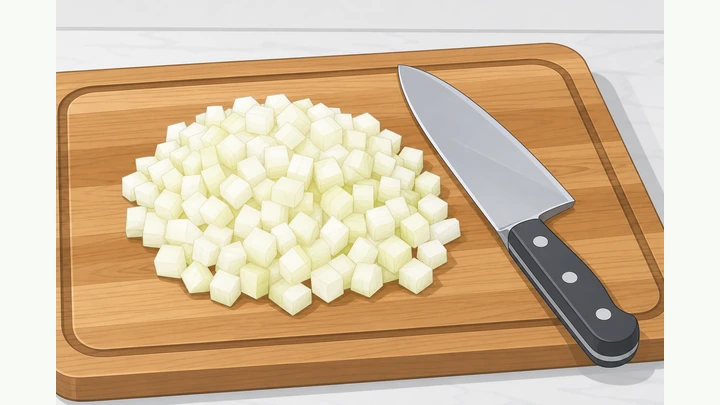
Things You'll Need
- 1 firm yellow or white onion (about medium size)
- Chef's knife or other sharp 7–8 inch knife
- Stable cutting board
- Bowl for the diced onion
- Kitchen towel or paper towels
- Optional: onion goggles or snug glasses for eye comfort
Where are you stuck?
Follow Start here for a first classic dice. If your eyes tear too much, the onion rocks, or the cubes are uneven, jump to the matching branch.
Start hereStem trim → root hinge → horizontal → vertical → cross-cut dice
30-second preflight — all three checks must be YES.
Firm onion · sharp knife · stable board · bowl and towel ready.
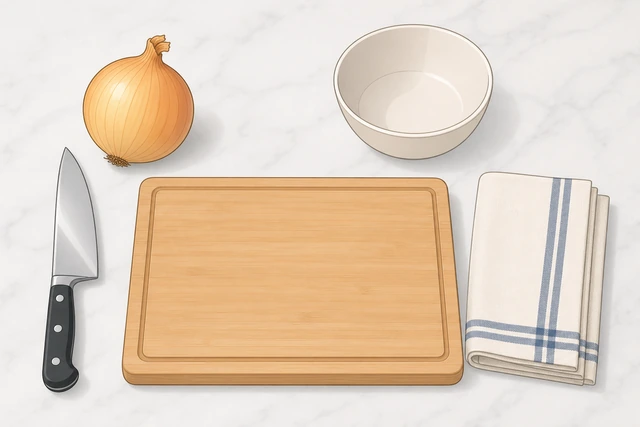
A dull knife or a wobbly board turns a simple cut into a slip — checking tools first keeps every later cut controlled.
- Onion ready? Firm yellow or white onion with dry outer skin — not soft or moldy.
- Tools out? Sharp chef's knife (or 7–8" knife), cutting board that does not slide, bowl, towel.
- Board safe? Board flat on the counter; put a damp towel under it if it skates.
All three checks are YES — you are ready to trim the stem end in Step 1.
Eyes already watering just from holding the onion? → Tearing eyes.
Trim about ¼ inch off the stem (top) end — leave the root on.
Cut ~¼ inch off the stem tip only; hairy root stays attached.
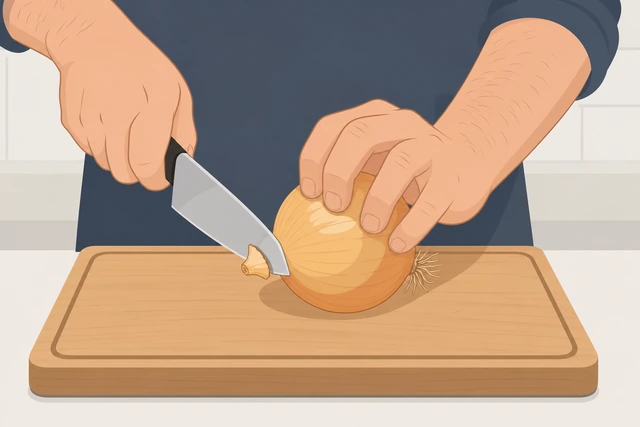
Removing only the stem gives you a flat starting face while the root still holds layers together for even cuts later.
- Set the onion on its side on the board so the stem tip faces you clearly.
- Hold with a claw grip — fingertips curled under, knuckles leading.
- Slice about ¼ inch (6 mm) off the stem tip; do not cut the root yet.
The stem end is cut flat and the root with its hairs is still fully attached.
Halve the onion through the root, then peel the outer skin.
Stand stem-down or on a flat face → cut through root → peel dry skin.
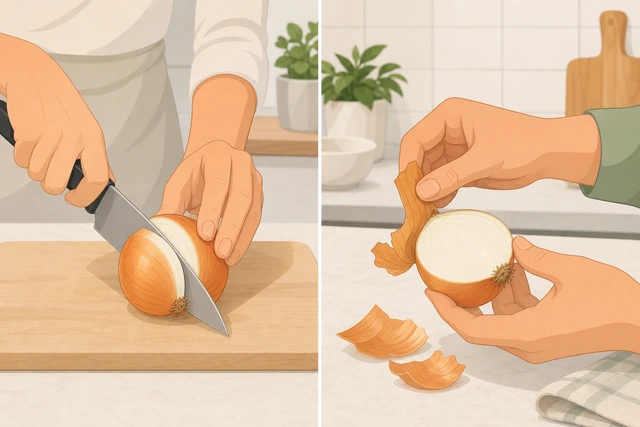
Cutting through the root keeps each half held together at the hinge so you can peel and slice without the layers falling apart.
- Place the onion so you can cut from the stem face straight down through the root.
- Cut firmly into two equal halves.
- Peel off the dry papery skin (and any tough outer layer) from each half.
You have two peeled halves, each still connected at the root hinge.
Put one half flat-cut side down so it sits steady.
Flat face against the board — half should not rock when you press lightly.
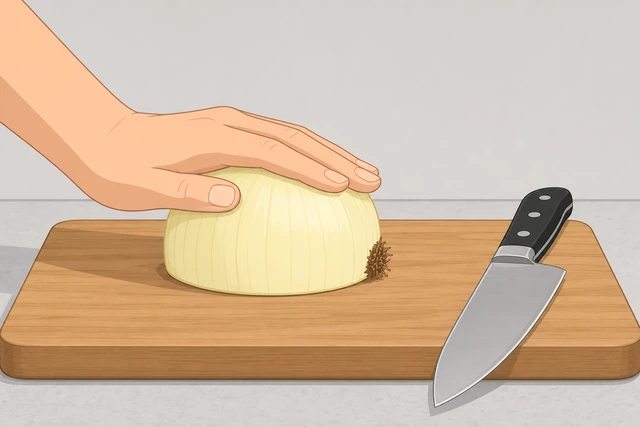
A curved face will rock under the knife and send the blade toward your fingers — the flat cut is what makes controlled dicing possible.
- Place one half cut-side down on the board.
- Press lightly with your fingertips — it should feel planted, not tippy.
- If it rocks, remake a thin flat cut on that face before continuing.
The half sits steady flat-side down with the root end facing sideways for the next cuts.
Still rocking or the knife starts to slip? → Onion slipping.
Make 1–2 horizontal cuts toward the root — stop short of the root.
1–2 parallel horizontal cuts; blade stops before the root hinge.
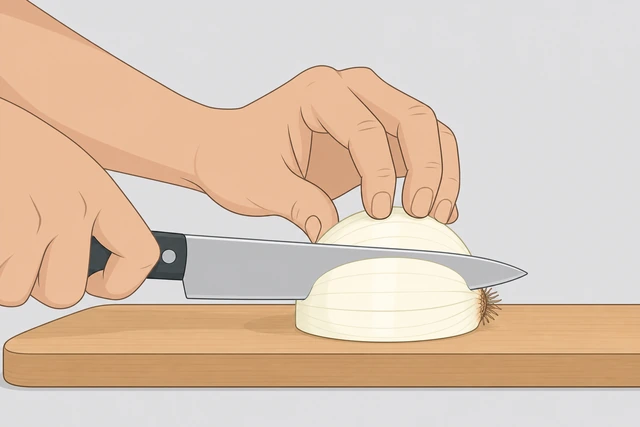
Horizontal cuts create the layers of the dice — stopping before the root keeps the onion from falling into loose sheets.
- Curl your guide hand into a claw; knuckles face the blade.
- With the knife parallel to the board, cut 1–2 horizontal slits from the stem side toward the root.
- Stop about ¼–½ inch before the root so the hinge stays connected.
You see 1–2 clean horizontal slits and the root still holding the half together.
Tears making the board hard to see? → Tearing eyes.
Make even vertical cuts toward the root — still leave the hinge.
Even vertical cuts ~¼–½ inch apart; stop short of the root.
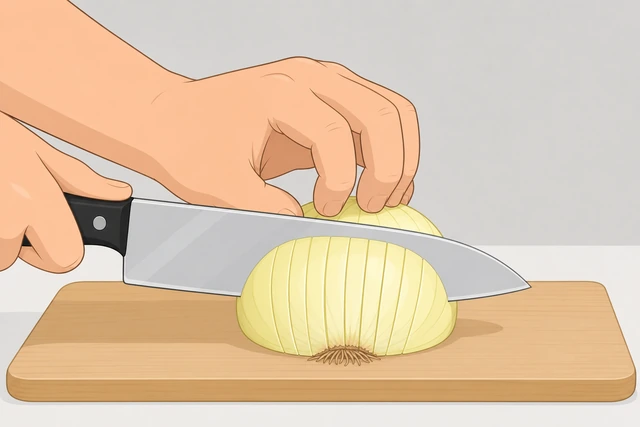
Vertical cuts set the width of each cube — the intact root is what keeps those strips lined up for the final cross-cuts.
- Keep the claw grip; never point fingertips at the blade.
- Cut straight down in parallel lines about ¼–½ inch apart from stem toward root.
- Again stop short of the root so strips stay attached.
The half looks like even strips still joined at the root end.
Onion starts sliding or rocking mid-cut? → Onion slipping.
Cross-cut across the half into dice, then discard the root nub.
Slice across into cubes, then trim off and discard the root end.
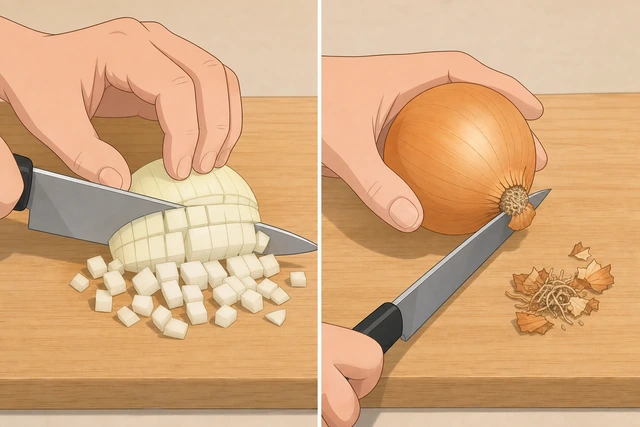
These final perpendicular cuts turn the held-together strips into cubes; trimming the root last removes the tough nub after it has done its job.
- Rotate the half if needed so you slice across the strips.
- Cut into dice about ¼–½ inch wide, matching your earlier spacing.
- When you reach the root, trim it off in one piece and discard (or compost).
A pile of onion cubes sits on the board and the tough root nub is gone.
Big mix of large chunks and skinny shards? → Uneven dice.
Repeat the same cuts on the second half.
Flat down → horizontal → vertical → cross-cut on the other half.
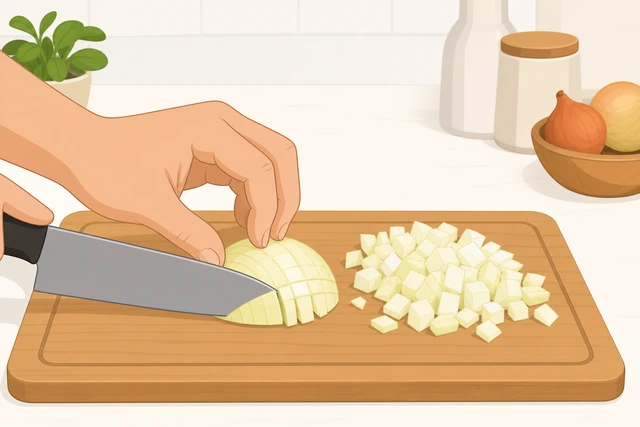
Repeating the same sequence keeps both halves consistent so the whole onion cooks evenly later.
- Place the second half flat-cut side down.
- Repeat Steps 4–6: horizontal, vertical, then cross-cut.
- Discard the second root nub the same way.
The entire onion is diced into one pile of cubes.
Scoop the dice into a bowl and wipe the board.
Move cubes to a bowl; wipe peels and juice off the board.
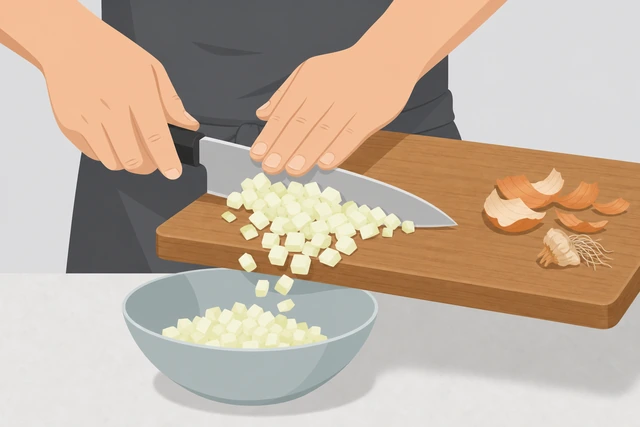
Getting dice off the board right away keeps them from drying out or picking up loose peel bits and excess juice.
- Use the flat of the knife or a bench scraper to push dice into the bowl.
- Push peels and the root nubs into trash or compost.
- Wipe the board with a towel so it is dry and clear.
Dice are in the bowl and the board is wiped clean of peels and scraps.
Rinse your hands and the knife, then dry the knife.
Rinse onion juice off hands and blade; dry the knife completely.
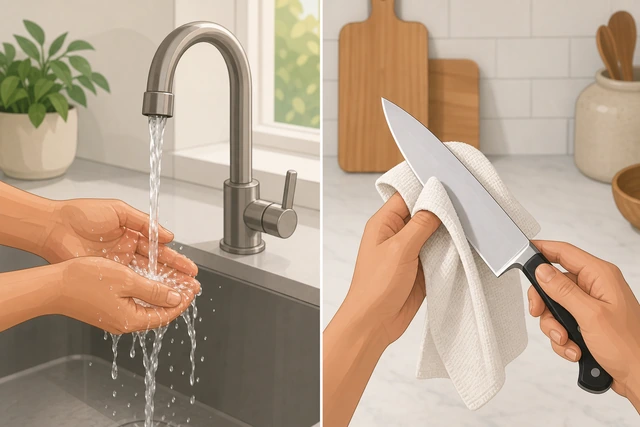
Onion juice on skin and steel stings and rusts — a quick rinse and dry finishes the job safely.
- Rinse your hands under cool water; pat dry.
- Rinse the knife carefully under running water, keeping fingers clear of the edge.
- Dry the knife fully with a towel before putting it away.
Hands are rinsed and the knife is clean and dry.
Spot-check: most pieces are roughly the same size.
Most cubes look about ¼–½ inch — ready for the pan or recipe.
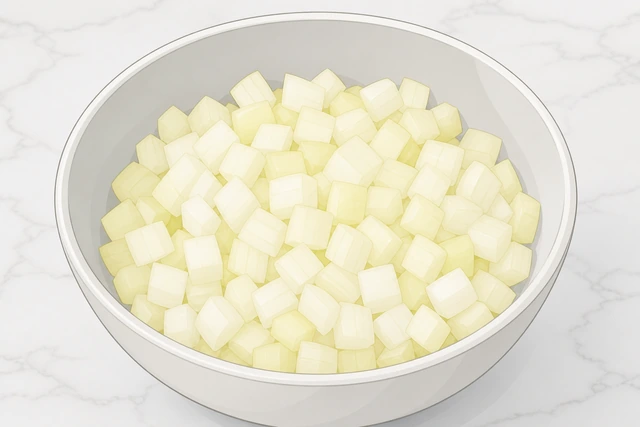
Even size means the onion browns and softens at the same rate instead of burning small bits while big chunks stay raw.
- Look into the bowl — most pieces should look roughly similar.
- If a few large pieces remain, re-cut only those (see the uneven branch if many).
- Your diced onion is ready to cook.
Most dice are roughly even (~¼–½ inch) and ready for cooking.
Lots of uneven pieces? → Uneven dice.
Eyes burning or too teary to seeVentilate, chill, or use eye protection — then resume
Pause cutting, open a window or turn on a fan, and step back.
Knife down, open air moving, wait until you can see clearly.
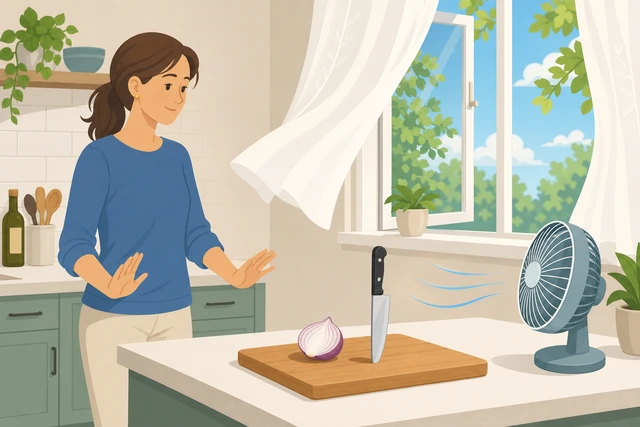
Cutting while blurry is how fingers get cut — airflow dilutes the vapors that irritate your eyes.
- Set the knife down on the board, blade away from the edge.
- Open a window or turn on a kitchen exhaust / small fan aimed across the board.
- Wait 30–60 seconds until your vision clears enough to see the onion edge.
Air is moving and you can see the cutting board clearly again.
Chill the onion 10–15 minutes or put on goggles, then finish the cuts.
Fridge 10–15 min and/or snug goggles or glasses — then resume dicing.
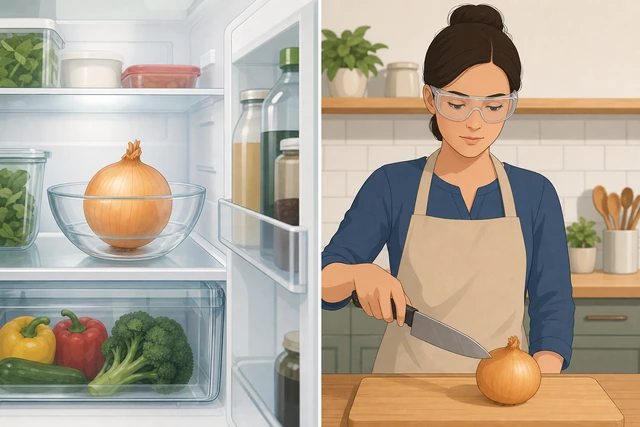
Cold slows the release of eye-irritating compounds; sealed eye protection blocks them from reaching your eyes.
- Put the onion (wrapped or in a bowl) in the fridge for 10–15 minutes, or put on onion goggles / snug glasses.
- Cut near running water or under a vent if it still bothers you.
- Return to the main path at the step you paused.
You can complete the remaining cuts without blurred vision.
Eyes keep burning badly after rinsing with clean water, or vision stays blurry — stop and get medical advice.
Onion rocking or knife slippingRemake a flat face, dry the board, reset the claw
Stop, remake a true flat face, and dry the board and onion.
Thin new flat cut + dry board and onion surface before any more cuts.
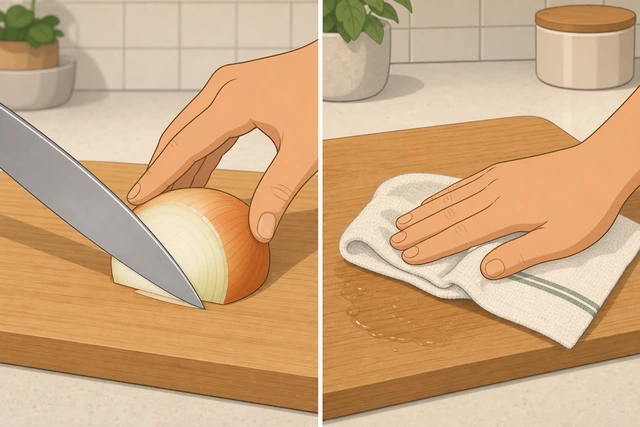
Moisture and a curved face are the two most common reasons a knife rides off — fix both before you continue.
- Put the knife down.
- Trim a thin new flat on the cut face if the half still rocks.
- Wipe the board and the onion dry with a towel.
The half sits plant-flat on a dry board with no rock when pressed.
Reset claw grip and take slower, shallower cuts.
Knuckles lead, fingertips curled under — shorter, slower cuts.
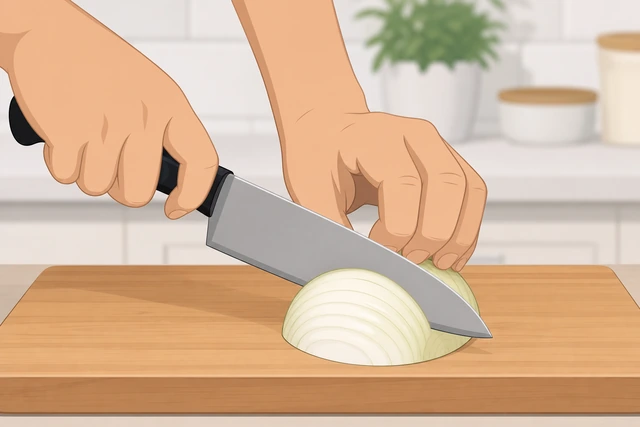
A renewed claw grip puts bone (knuckles) between the blade and soft fingertips, and slower cuts give you time to feel any slip early.
- Curl fingertips under; let knuckles face and guide the blade.
- Make shorter cuts with less force rather than one deep rush.
- Return to the main path at the cut you were attempting.
You can cut again with a steady half and a clear claw grip.
If you cut yourself: rinse, apply pressure, and stop knife work. Deep cut or bleeding that will not slow — get first aid / medical help.
Uneven dice — big chunks and thin shardsSort and re-cut only the large pieces
Pull the large pieces aside and leave tiny scraps for stock or discard.
Big pieces in one pile; tiny shards aside (stock or discard).
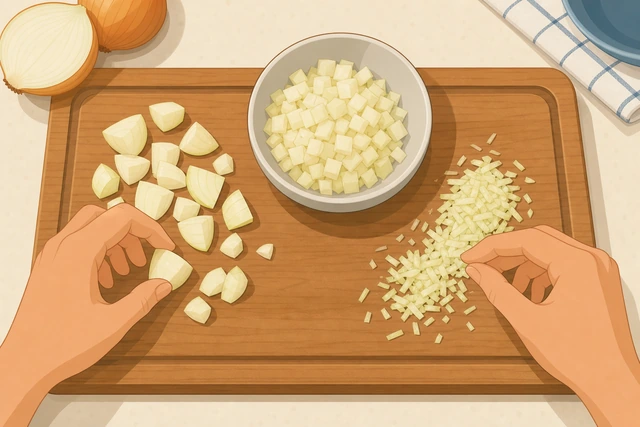
Re-cutting everything wastes time — only the oversized pieces affect even cooking.
- Scan the pile and push clearly oversized pieces to one side.
- Leave tiny thin shards for soup stock, or discard if you do not need them.
- Keep the mostly-even dice in the bowl.
Only the too-large pieces remain on the board for re-cutting.
Re-cut large pieces to match the rest; next onion, space cuts evenly.
Slice each large chunk once or twice to match ~¼–½ inch size.
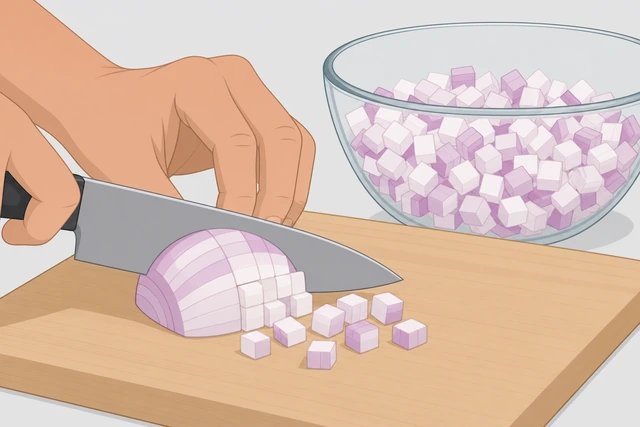
Matching size now fixes tonight's batch; more even spacing before the root next time prevents the problem.
- Lay each large piece flat and cut once or twice to match neighboring cubes.
- Return everything evenly diced to the bowl.
- Next onion: keep vertical and cross-cut spacing the same from tip to near the root.
The re-cut pile looks roughly even and is ready to cook.
When to get help
- Ask a helper to stand by for Steps 1–6 if knife work alone feels unsteady.
- If you cut yourself deeply or bleeding does not slow with pressure, get first aid or medical care.
- If eye pain is severe after onion vapors and vision stays blurry after rinsing with clean water, seek medical advice.
When This Doesn't Work
- Very small pearl onions. Skip the full horizontal-cut method — peel and quarter or mince instead; they are too small for a true dice sequence.
- Red onions for raw salad. Same cutting method; soak diced red onion in cold water 5–10 minutes if you want milder bite.
- Only a serrated or dull knife. Serrated knives crush more than they slice — sharpen or switch to a chef's knife before you start a full dice.
Warnings
- Never cut toward your hand or with fingertips pointed at the blade — use a claw grip every cut.
- Do not try to catch a falling knife — step back and let it drop clear of your feet.
- Stop cutting if tears blur your vision; resume only when you can see the onion edge clearly.
- Keep the knife tip on or near the board when pausing — never wave a blade in conversation.
Tips
- A sharper knife tears fewer cells and usually means fewer tears for your eyes.
- Chilling the onion 10–15 minutes before cutting reduces eye burn for many people.
- If you only need a rough chop for soup, you can skip the horizontal cuts and just do vertical then cross-cut — dice is finer and more even than a rough chop.
FAQ
Why leave the root on until the end?
The root acts like a hinge that holds the layers together while you make horizontal and vertical cuts. If you trim it off first, the onion falls into loose sheets and the dice become uneven.
What size should diced onion be?
About ¼–½ inch (6–12 mm) cubes is the usual cooking size. Match your recipe if it asks for finer mince or larger chunks.
How do I stop crying when cutting onions?
Work near a fan or open window, chill the onion first, use a sharp knife, and consider onion goggles. Pause if you cannot see the board clearly.

Comments
Questions, corrections, and what worked for you. Comments are reviewed before they appear.