How to Clean Glass Windows
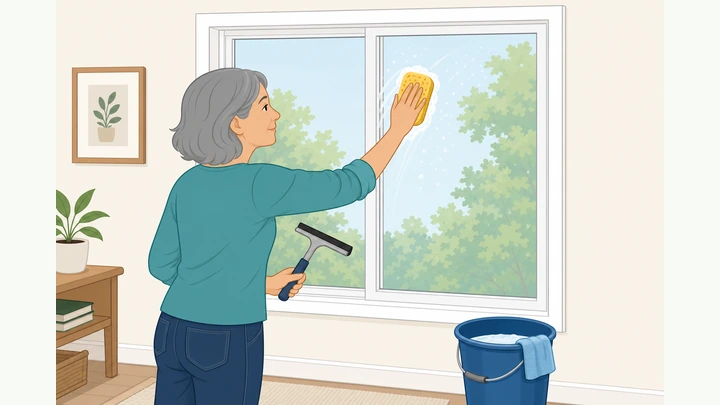
Clean glass windows streak-free — inside and ground-floor outside — in about 45 quiet minutes. Work in shade, dry-dust frames first, wash top to bottom, squeegee with a dry blade between passes, then inspect in raking light. Read one step at a time. Start with the preflight. Streaks or lint lines after inspection? See streaks and lint. Second-story exterior? See high exterior.
Tips for reading this guide
- One step at a time. Read the green caption, the Why line, then the bullets.
- Move on when the green done line is true — then go to the next step.
- Shade first. Work on a cloudy day or in shade — sun on the glass dries solution before you can squeegee.
- Less soap, not more. A few drops of dish soap per bucket is enough; too much leaves a filmy streak.
- Streaks won't go away, or upstairs exterior out of reach? Jump to the matching branch below.
- Need a helper? Ask someone you trust to steady a ladder, pass cloths, or check on you if height feels unsafe.
Things You'll Need
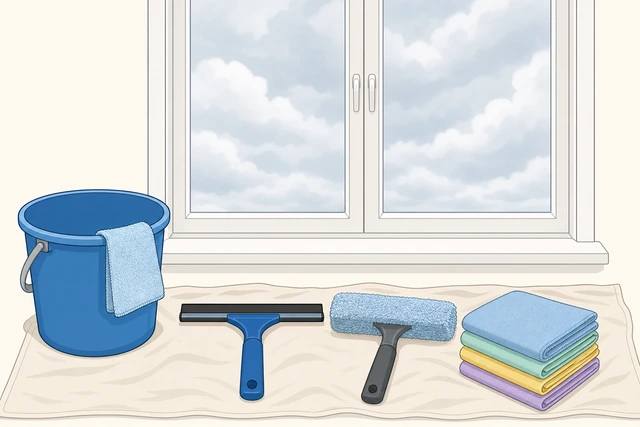
- Bucket with warm water
- Few drops of dish soap OR 1:1 white vinegar and water — pick one, not both; skip ammonia on tinted or coated glass
- Squeegee with a clean, nick-free rubber blade
- Washer sleeve, sponge, or microfiber cloth for wet washing
- Several dry microfiber cloths — keep separate cloths for dirty frame work vs. final glass polish
- Drop cloth or old towel to lay under the sill
- Soft brush or dry cloth for dry-dusting frames and tracks before any wet step
- About 45 quiet minutes for several panes; cloudy or shaded conditions preferred
Where are you stuck?
Follow Start here for a full inside-and-ground-floor clean. Jump to a branch if streaks survive the raking-light check, or exterior panes are above safe reach.
Start hereShade → dry-dust → mix solution → wash top to bottom → squeegee → edges → both sides → frame/sill → next pane → exterior → raking-light inspect → touch up
Preflight — shade, supplies, drop cloth, and access before any water touches the glass.
Cloudy or shaded · bucket, squeegee, cloths ready · towel under sill · windows unlocked if needed.
Direct sun dries solution in seconds and causes instant streaks; dry-dusting first stops frame grit from turning into muddy smears the moment a wet cloth hits it.
- Shade or cloud cover? Pick a cloudy day or wait until the pane is in shade, not direct hot sun.
- Supplies gathered? Bucket, squeegee, washer/sponge, and dry microfiber cloths are within reach.
- Drop cloth down? Lay a towel or drop cloth under the sill to catch drips, especially on wood.
- Windows unlocked? Open or unlock any windows you need to reach both sides safely.
You are working in shade or cloud cover, supplies are ready, a drop cloth is under the sill, and windows are unlocked if needed.
Work in shade or on a cloudy day — direct sun on the glass dries the solution in seconds before you can squeegee, which is the #1 cause of instant streaks. Already know you streak easily? See Streaks and lint after Step 11.
Dry-dust the frame, sill, and screen track.
Brush or dry cloth · frame · sill · screen track · no loose dust or cobwebs.
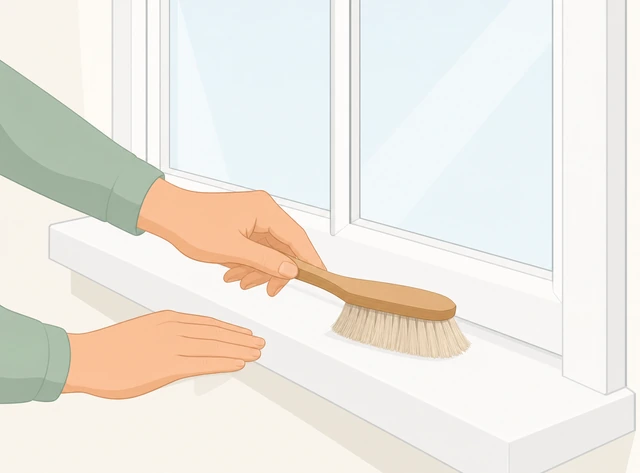
Wetting dry dust on a frame turns it into mud that streaks across the lower third of the pane — dry-dusting first is what keeps that grit off the glass.
- Use a soft brush or dry cloth on the frame, sill, and screen track.
- Knock loose dust and cobwebs free before any liquid touches the glass.
- Do not skip the track — grit there smears the pane when you wash.
Frame, sill, and track are dust-free with no loose cobwebs or grit.
Mix a light cleaning solution.
Few drops dish soap in warm water OR 1:1 vinegar/water · not sudsy · never ammonia on coated glass.
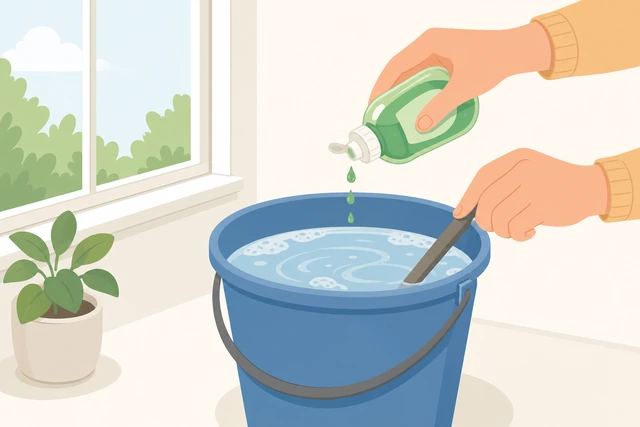
Too much dish soap leaves a filmy residue that streaks no matter how perfect the squeegee pass — a few drops per bucket is the right dose, not a squirt.
- Fill a bucket with warm water.
- Add a few drops of dish soap, OR mix equal parts white vinegar and water — pick one route.
- The water should look slightly soapy or vinegar-scented, not thick with suds.
Solution is mixed and looks lightly soapy or vinegar-scented, not sudsy or cloudy with soap.
Skip ammonia on tinted, low-E, or coated glass — it can damage the film. A few drops of dish soap in water or a 1:1 vinegar/water mix is safer on unknown coatings.
Dip the washer and wring until damp, not dripping.
Soak washer or sponge · wring firmly · lifts damp, no drips falling.
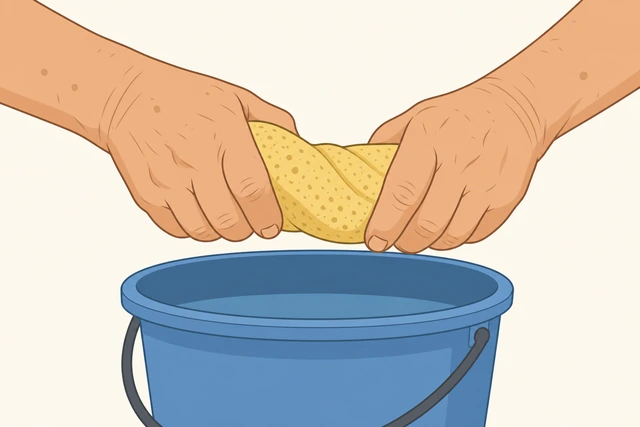
A dripping washer floods the sill and leaves excess solution that dries into streaks before you can squeegee — damp is the target, not soaked.
- Dip the washer sleeve, sponge, or microfiber into the bucket.
- Wring or squeeze firmly until water stops dripping off.
- Lift it — it should feel damp and hold water, not drip.
The washer is damp and holds water but does not drip when lifted.
Wash the glass top to bottom in overlapping strips.
Start at the top · overlapping vertical strips or loose S-pattern · entire pane coated.
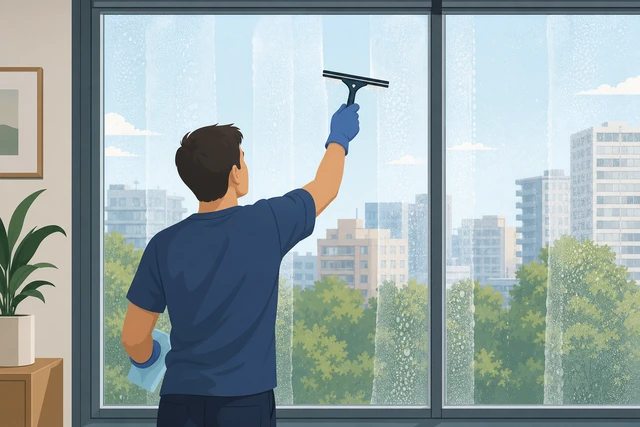
Working top to bottom lets solution flow down over areas you have not squeegeed yet, and overlapping strips guarantee no dry patches that flash-streak in sun or breeze.
- Start at the top edge of the pane and work downward.
- Use overlapping vertical strips or a loose S-pattern across the glass.
- Coat the entire pane so no dry patches remain before you squeegee.
The whole pane is coated with solution and has no dry patches.
Squeegee from the top in horizontal passes.
Top edge first · horizontal passes overlap · dry blade on lint-free cloth between each pass.
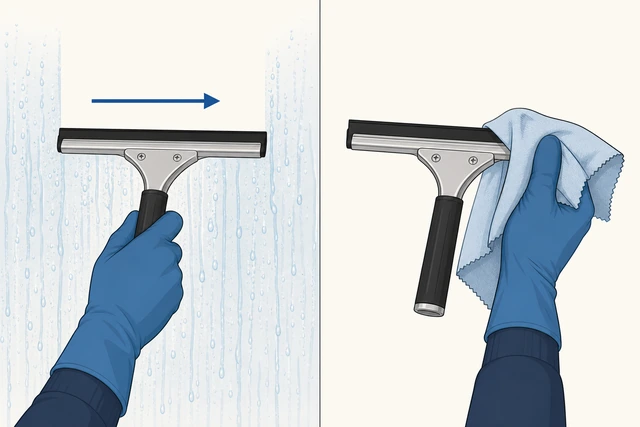
A wet or dirty blade drags a thin grime line across every pass — wiping the rubber dry between passes is what separates streak-free glass from a smeared pane.
- Place the squeegee at the top edge and pull across in a horizontal pass.
- Overlap each pass slightly so no wet band is left between strokes.
- Wipe the blade dry on a lint-free cloth before every next pass.
Water film is removed in even strips and the blade was wiped dry between each pass.
Blade leaves a line on every pass even when wiped? → Streaks and lint.
Wipe drips from edges, corners, and muntins.
Dry microfiber · edges · corners · muntins/grid lines the squeegee missed.
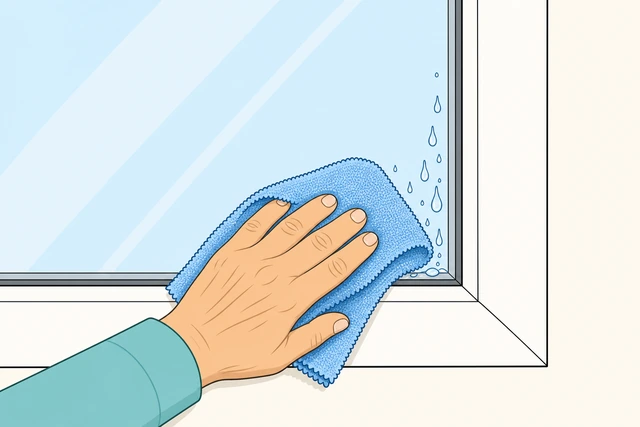
The squeegee cannot reach tight corners, muntins, or the bead along the frame — those spots hold drips that dry into visible streaks if left alone.
- Take a dry microfiber cloth to the edges and corners of the pane.
- Wipe along muntins or grid lines where the squeegee could not reach.
- Catch any beads or drips before they dry on their own.
Edges, corners, and muntins are dry with no beads or drips left.
Repeat wash and squeegee on the other side if safely reachable.
Other side of same pane · same wash-and-squeegee sequence · only if safe to reach.
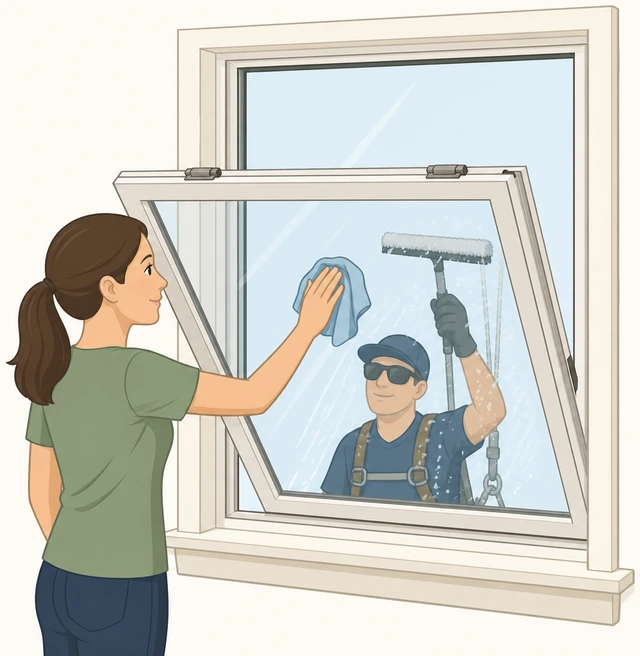
Cleaning only one side leaves smears visible from the other direction — but only repeat when you can reach without leaning out or overreaching.
- Move to the opposite side of the same pane if you can reach it safely.
- Repeat the wash top to bottom, then squeegee with dry blade between passes.
- Detail edges and corners with a dry microfiber as in Step 6.
Both safely reachable sides of this pane are washed, squeegeed, and edge-detailed.
Wipe the frame and sill damp, then dry.
Damp cloth on frame and sill · separate dry cloth · no standing water on wood.
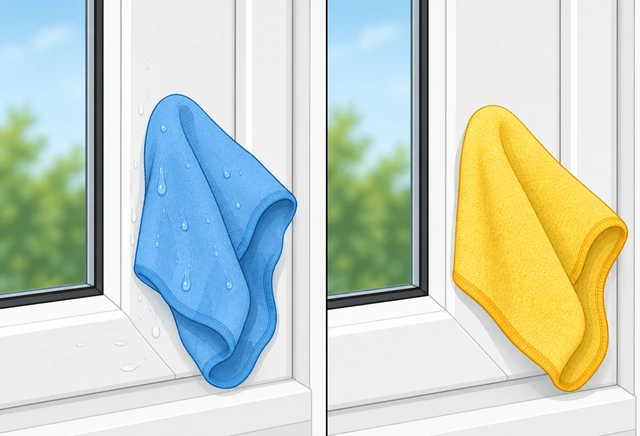
Frame and sill collect the dirtiest wash water — using a separate cloth here keeps grit off the clean glass you just polished.
- Wipe the frame and sill with a damp cloth — not the one you use for final glass polish.
- Follow with a separate dry cloth to remove standing water.
- Pay extra attention to wood sills so no water soaks in.
Frame and sill are clean with no standing water, especially on wood.
Move to the next pane and refresh solution if dirty.
Next pane · dump and remix if water looks gray or gritty · fresh solution per room.
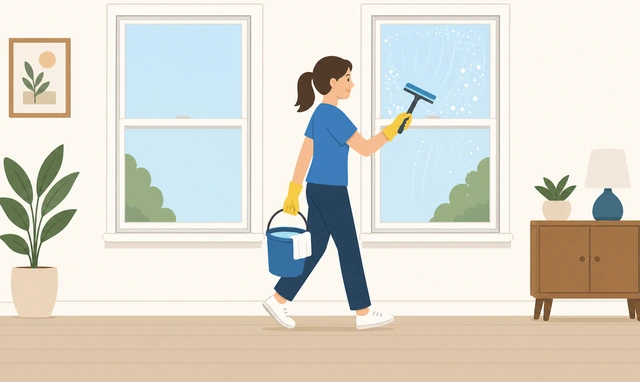
Gray or gritty bucket water re-deposits dirt on every new pane — refreshing solution is faster than re-washing a pane you already thought was done.
- Move to the next pane and repeat Steps 4–8.
- If the bucket water looks gray, cloudy, or gritty, dump it and remix.
- Use fresh-looking solution for each room or whenever the water turns dirty.
You moved to the next pane with clean-looking solution in the bucket.
Clean ground-floor exterior with the same technique.
Wasp/debris check · same wash + squeegee · ground-floor reach only.
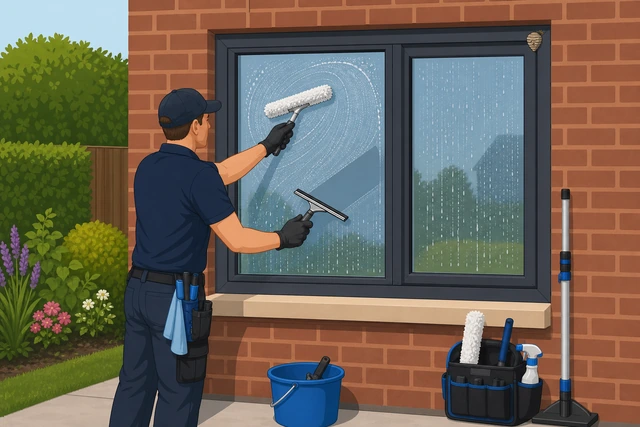
Exterior panes collect pollen and road film that interior cleaning never touches — but only tackle what you can reach safely from the ground or an open ground-floor window.
- Glance for wasp nests or loose debris around the exterior frame before you start.
- Wash and squeegee reachable ground-floor exterior panes with the same technique.
- Do not lean a ladder against the glass or overreach — see the high-exterior branch instead.
Ground-floor exterior panes you could safely reach match the interior clarity.
Exterior above safe ground-floor reach? → High exterior.
Inspect at a 45° angle in raking light.
View pane at an angle to light · look for streaks, haze, missed spots.
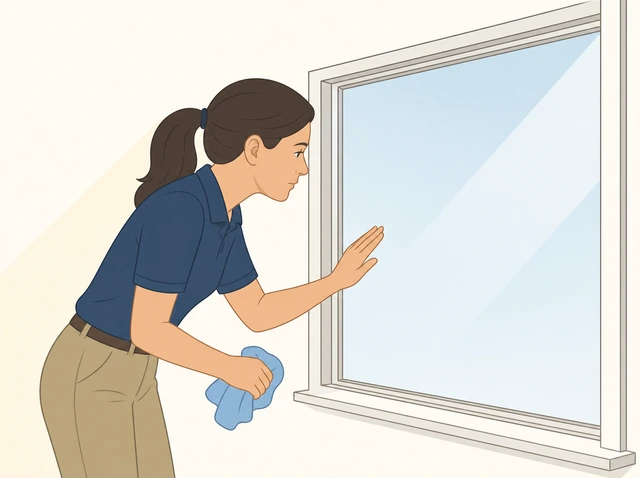
Streaks and haze that disappear when you look straight on show up only in raking light — this angled check is the real quality gate before you call a pane done.
- Stand to one side and view the pane at roughly a 45° angle to the light.
- Scan for streaks, haze, lint lines, or missed spots head-on viewing hides.
- Mark any pane that still shows marks — you will touch up in the next step.
You have checked each pane in raking light and noted any remaining streaks or haze.
Streaks or lint lines still visible at an angle? → Streaks and lint.
Touch up streaks, rinse tools, and wash hands.
Barely damp microfiber on streaks · dry-polish · rinse squeegee and bucket · wash hands.
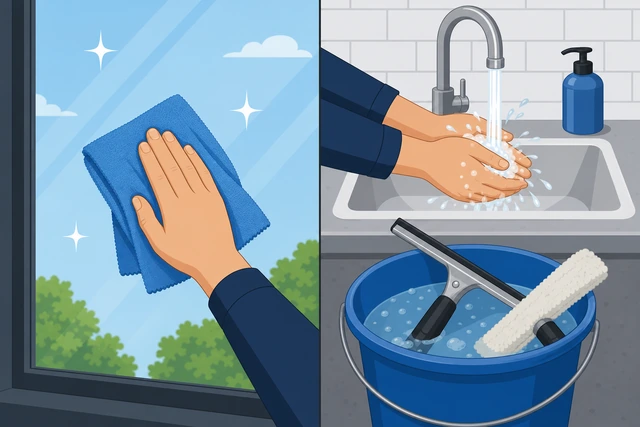
A final dry-polish on lingering streaks fixes what the squeegee missed, and rinsing tools now prevents dried soap from ruining the next session.
- Touch up any streaks with a barely damp microfiber, then dry-polish with a clean dry cloth.
- Rinse the squeegee, washer, and bucket with clean water.
- Wash your hands when finished.
Streaks are gone or touched up, tools are rinsed, and hands are washed.
Streaks and lintStreaks, haze, or lint lines remain after the raking-light check
Dump the bucket, remix with less soap, and clean the blade.
Fresh plain or light solution · wipe blade with vinegar on cloth · flip to fresh rubber edge.
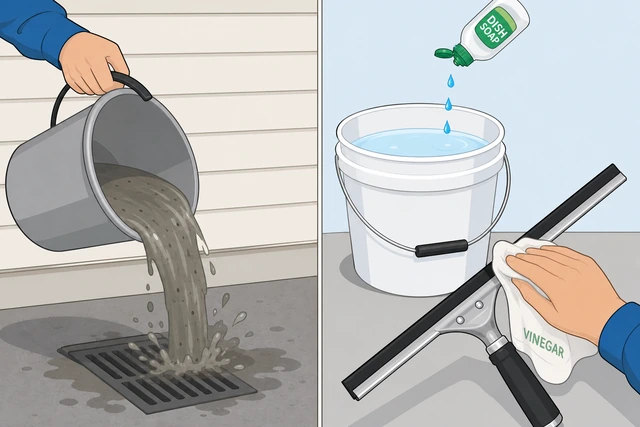
Too much soap film and a nicked blade are the two most common streak causes after a "perfect" technique pass — fixing chemistry and rubber comes before scrubbing harder.
- Dump the bucket and remix with less soap, or use plain water only.
- Wipe the squeegee blade with vinegar on a cloth to remove film and grime.
- Flip or replace the rubber to a fresh, nick-free edge.
Fresh light solution is in the bucket and the squeegee blade is clean on a fresh rubber edge.
Re-wash one pane with crossed passes, then dry-polish only.
Inside: vertical squeegee strokes · outside: horizontal (or vice versa) · final dry microfiber only.
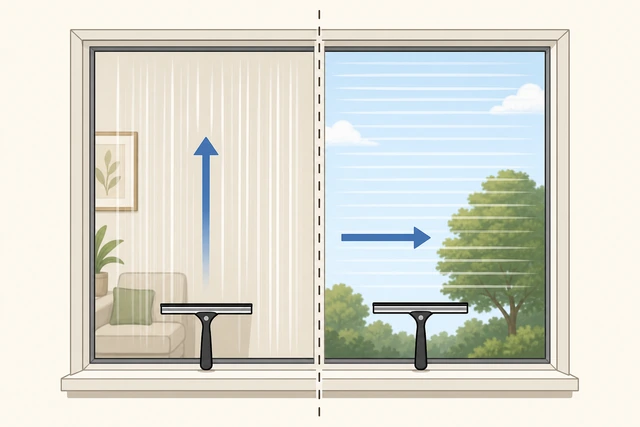
Crossing stroke direction on inside vs. outside tells you which side holds the streak, and a final dry-polish with no extra solution lifts lint without adding new film.
- Re-wash one problem pane and squeegee with vertical strokes on the inside.
- Use horizontal strokes on the outside — or the reverse — so you can tell which side streaks.
- Finish with a clean, dry microfiber polish only — no extra solution on the final pass.
The pane was re-passed with crossed stroke directions and dry-polished with no extra solution.
Streaks persist after two full remix-and-repass rounds on the same pane, or haze looks trapped between double-pane layers? That fog is inside a sealed unit — stop scrubbing and consider glass replacement or a pro.
High exteriorExterior panes above ground floor or out of safe reach from inside
Set up safely — never lean a ladder against the glass.
Three-point ladder contact on firm ground OR extension pole washer/squeegee · no glass contact.
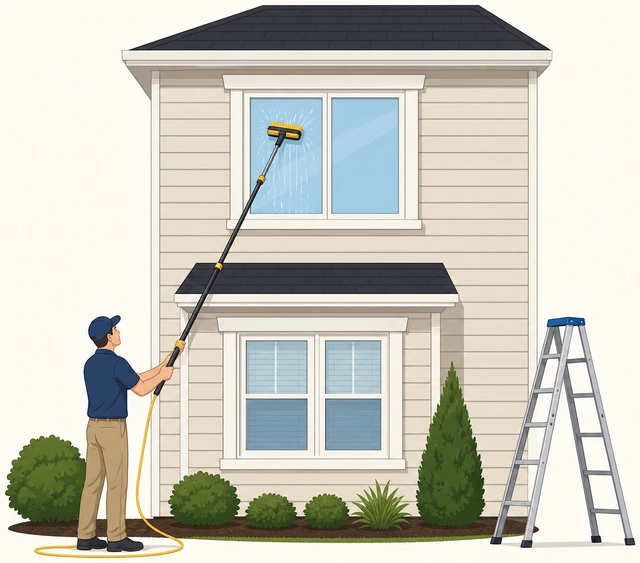
Leaning a ladder against glass can crack the pane; overreaching from a ladder or window is a common fall cause — pole tools or proper ladder placement come first.
- Do not lean any ladder against the window glass — it can crack the pane.
- Use a ladder with three-point contact on firm, level ground, or an extension pole washer/squeegee.
- Check that shoes, rungs, and ground are dry and stable before you climb.
You have a safe setup — pole tools ready or a ladder placed with three-point contact, never against glass.
Work top-down with pole tools; stop if anything feels unsafe.
Pole-wash high sections · pole-squeegee down · detail edges from open window if safe · stop if wobbly.
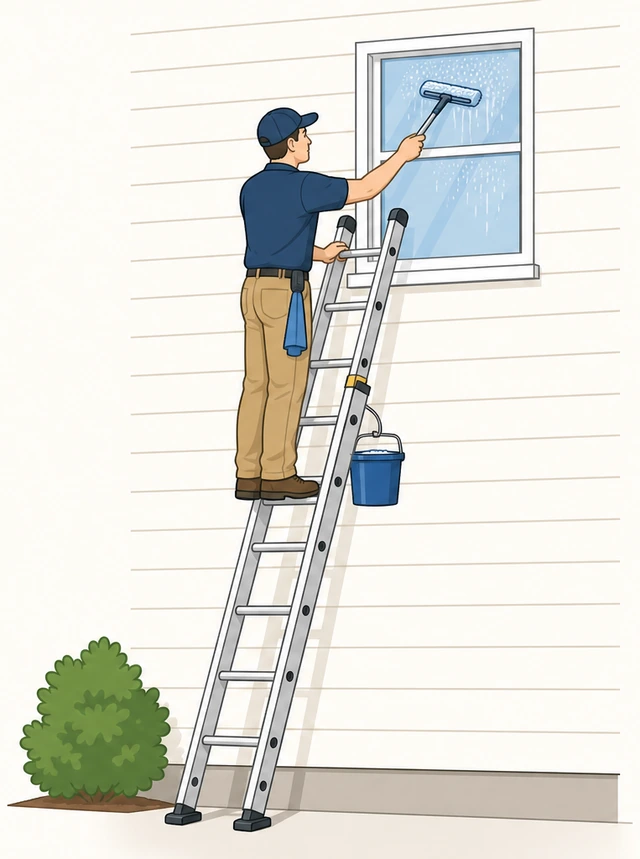
Top-down exterior work lets dirty water run over areas you have not cleaned yet, and stopping early beats a fall or a cracked pane from pushing past safe reach.
- Wet the exterior top-down with a pole washer, then squeegee downward with the pole tool.
- Detail edges from an open window only if you can do so without leaning out.
- Move the ladder or pole instead of stretching — stop and hire a pro if balance or wind feels unsafe.
High exterior sections you could reach safely are washed top-down, or you stopped because conditions were unsafe.
Any wobble, wind gust, or loss of three-point ladder contact? Stop immediately and hire a professional window cleaner — do not overreach.
When to get help
- Ask a trusted person to steady a ladder, pass cloths, or watch for traffic if you are working near a sidewalk or driveway.
- Any wobble, wind gust, or loss of three-point ladder contact while cleaning high exterior glass? Stop and hire a professional window cleaner.
- Streaks persist after two full remix-and-repass rounds on the same pane? Consider a pro, or check whether haze is trapped between sealed double-pane layers.
- Fog or haze between double-pane layers is a failed sealed unit — call a window professional for replacement, not more scrubbing.
- Painted-shut windows, rotting sills, or cracked glass need repair before cleaning — call a window or carpentry pro rather than forcing access.
When This Doesn't Work
- Glass is in direct sun right now. Wait for shade or a cloudy day — solution flash-dries and streaks before you can squeegee.
- Tinted, low-E, or coated glass with unknown care rules. Skip ammonia entirely; stick to a few drops of dish soap or a vinegar/water mix on interior panes only.
- Haze or fog between double-pane layers. That is a failed sealed unit — no amount of scrubbing clears it; consider glass replacement or a professional.
- Second-story or higher exterior you cannot reach safely. Do not lean a ladder on glass or overreach — see High exterior or hire a pro.
- Painted shut windows, damaged frames, or rotting wood sills. Forcing them open or soaking rotten wood causes more damage — address repairs before a deep clean.
- Construction-grade cement, paint overspray, or hard water etching. Household window solution will not remove cured paint or etched mineral damage — call a glass restoration pro.
Warnings
- Never lean a ladder against window glass. The pressure can crack the pane; use three-point contact on firm ground or extension pole tools instead.
- Do not use ammonia on tinted, low-E, or coated glass. It can damage the film or void a warranty — dish soap or vinegar/water is safer on unknown coatings.
- Do not work on exterior windows in high wind, on wet rungs, or when you feel unsteady — stop and hire a professional window cleaner.
- Do not overreach from a ladder or open window — move the ladder or pole instead of stretching.
- Do not skip the dry-dust step — wetting dry frame grit creates muddy streaks that look like bad glass technique.
- Do not use newspaper on white frames or coated glass — ink stains frames and can micro-scratch some coatings; microfiber and squeegee are the reliable tools.
Tips
- Pick a cloudy day or work when the pane is in shade — it is the single biggest streak-prevention move.
- A few drops of dish soap per bucket beats a heavy squirt; too much soap leaves a film that no squeegee technique fixes.
- Flip or replace squeegee rubber the moment it nicks or leaves a line every pass — blame the blade before the glass.
- Keep one cloth for dirty frame/sill work and a separate dry microfiber for final glass polish so grit never crosses back.
- Change bucket water when it looks gray — fresh solution per room saves a second pass on panes you already finished.
FAQ
What is the best homemade window cleaning solution?
A few drops of dish soap in warm water, or a 1:1 mix of white vinegar and water for light mineral film. Use only a few drops of soap — not a squirt — and skip ammonia on tinted or coated glass.
Why do my windows streak even after squeegeeing?
Usually direct sun drying the solution too fast, too much dish soap leaving film, or a dirty/nicked squeegee blade. Work in shade, remix with less soap, and wipe the blade dry between every pass — see the streaks branch if marks remain in raking light.
Can I use newspaper instead of a squeegee?
Newspaper is a common hack but it can leave ink on white frames and micro-scratch some coatings. A squeegee with dry blade wipes plus a microfiber for edges is more reliable and safer on coated glass.
How do I clean second-story exterior windows safely?
Never lean a ladder against the glass. Use extension pole washer/squeegee tools, or a ladder with three-point contact on firm ground — see the high-exterior branch. If you feel any wobble or wind gust, stop and hire a professional.
What if haze is between the two panes of a double-glazed window?
That fog is inside a failed sealed unit — scrubbing the outside will not clear it. The insulated glass unit likely needs replacement; contact a window professional rather than continuing to clean.
Comments
Questions, corrections, and what worked for you. Comments are reviewed before they appear.